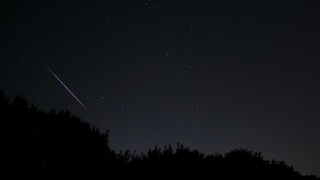
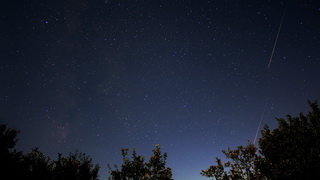
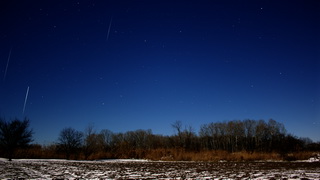
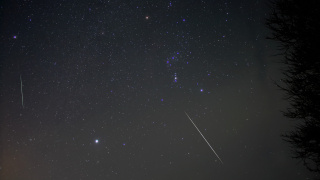
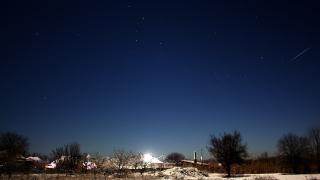
Perseids 2020
The Perseids are one of the brightest and most spectacular meteor showers of the year. Their parent body is Comet Swift–Tuttle (109P/Swift-Tuttle), which leaves behind a stream of dust and particles. Every August, Earth passes through this trail, and dozens of “shooting stars” appear in the atmosphere. The radiant of the shower (the point from which the meteors appear to originate) is located in the constellation Perseus. The entry speed of the particles into the atmosphere reaches about 59 km/s. The peak activity occurs in mid-August, when under good conditions up to 100 meteors per hour can be seen.
On August 12, 2020, I planned to observe the Perseids near the city of Dnipro. The conditions promised to be favorable: clear sky and the Moon in its last quarter phase, which did not interfere with observations in the first half of the night. But observing in the yard under strong urban light pollution was not appealing at all. I wanted to see a real starry sky — and, of course, shooting stars. Even on the outskirts of the city, this is impossible to achieve.
I carefully studied light pollution maps and recalled nighttime bike rides out of town. There, the sky is noticeably darker than within city limits. Of course, dreaming of a completely black sky was out of the question — nearby there are still settlements, streetlights, and highways. But finding a “green zone” was quite realistic. That is already much better than an orange or red zone. All that remained was to choose a spot reachable by bike, preferably no farther than 20 kilometers from the city outskirts, so as not to rack up too much distance deep into the night.
The choice fell on a field between the villages of Novotaromske, Dolynske, and Mykolaivka. There is a good dirt road there where I had ridden my bike before. Getting there is not difficult: you exit the city through Taromske and then ride across the field. It is quiet there, with few settlements around, no bright sources of light pollution, and no nearby highways. All this made the location suitable for observations.
As dusk fell, I set off. The ride took about an hour, and by the time I arrived, the sky had already darkened sufficiently. I rode along the dirt road until I found a spot where no bright lights were visible on the horizon. In the northeastern part of the sky, Dnipro glowed, and faint light from nearby villages was occasionally visible. Riding farther made no sense: a few kilometers ahead there is a highway and the fairly large village of Mykolaivka. It would only be worse there, so I stopped here.
I called this place “Starry Meadow.” And the name is fully justified: despite some light-polluted areas, there were many times more stars here than even on the city outskirts. The Milky Way became clearly visible above the horizon, and the silence around felt unusual and even a bit eerie. But it was here that the feeling of unity with the stars appeared — the very reason it was worth the trip.
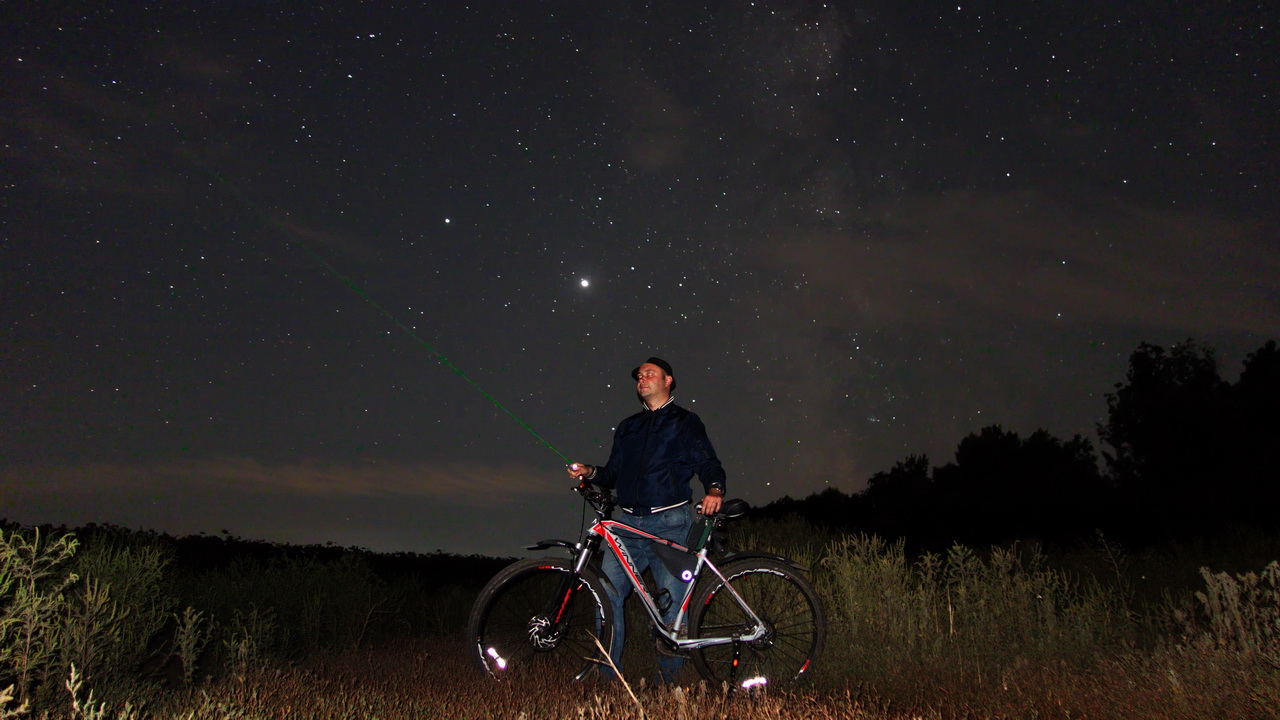
At first, the sky was quiet, but soon the Perseids began to flash. Bright white and greenish meteors streaked across the sky, some leaving short glowing trails. In an hour and a half of observing, I saw more than 50 meteors, over a dozen of which were very bright, and several were especially impressive in brightness and length. This spectacle remained in my memory for a long time and became one of the strongest impressions of my astronomical experience.
I also brought along a compact camera, the Sony DSC-RX100, to try photographing the starry sky. Such an opportunity doesn’t come every day! For its class, the RX100 produces decent shots: it has a fast lens and a good sensor. But, of course, the camera is not designed for astrophotography. The starry sky is best captured with series of long exposures, which are then stacked in specialized software (such as Sequator or DeepSkyStacker) to reduce noise and bring out details. The RX100 lacks the ability to automatically shoot long series, so I had to manually press the shutter each time — which proved quite tiring. Nevertheless, I managed to take several series of shots of different sky areas.
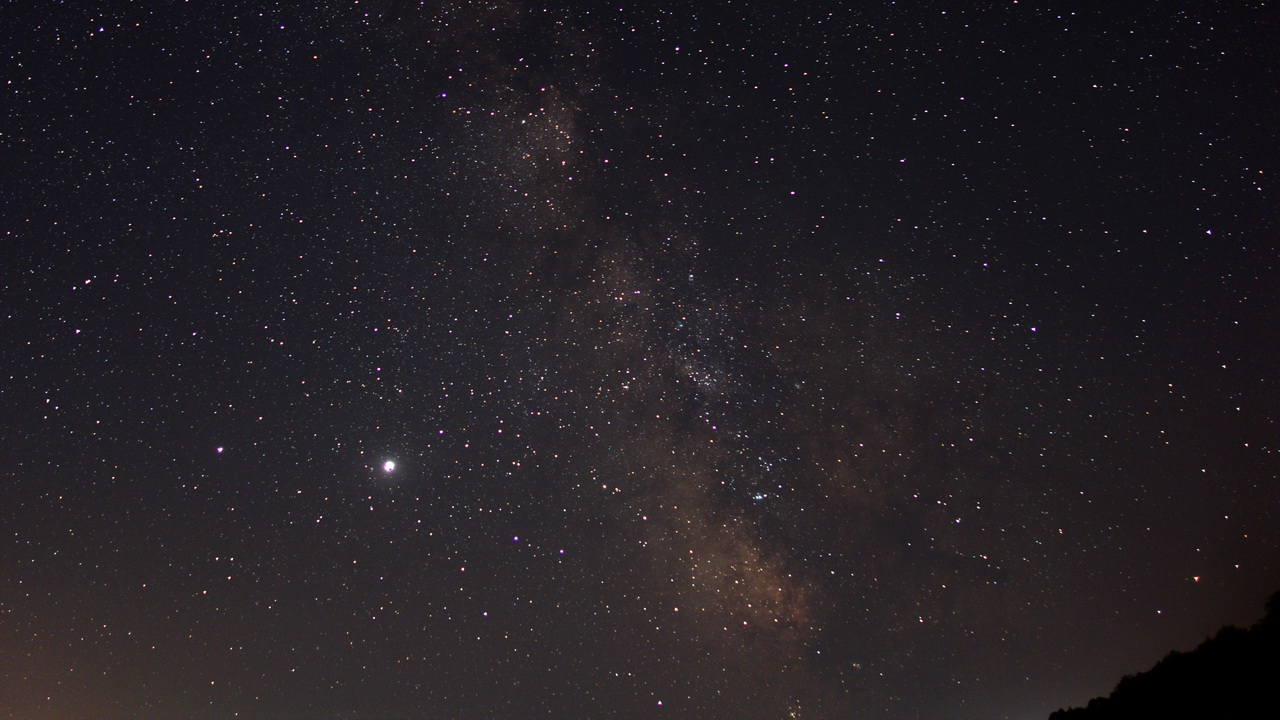
For each final frame, I took about 20 exposures. Despite the camera’s limitations, the results turned out quite respectable: the final photos preserved the memory of that unusual night under the Perseids and conveyed the atmosphere of the starry sky.
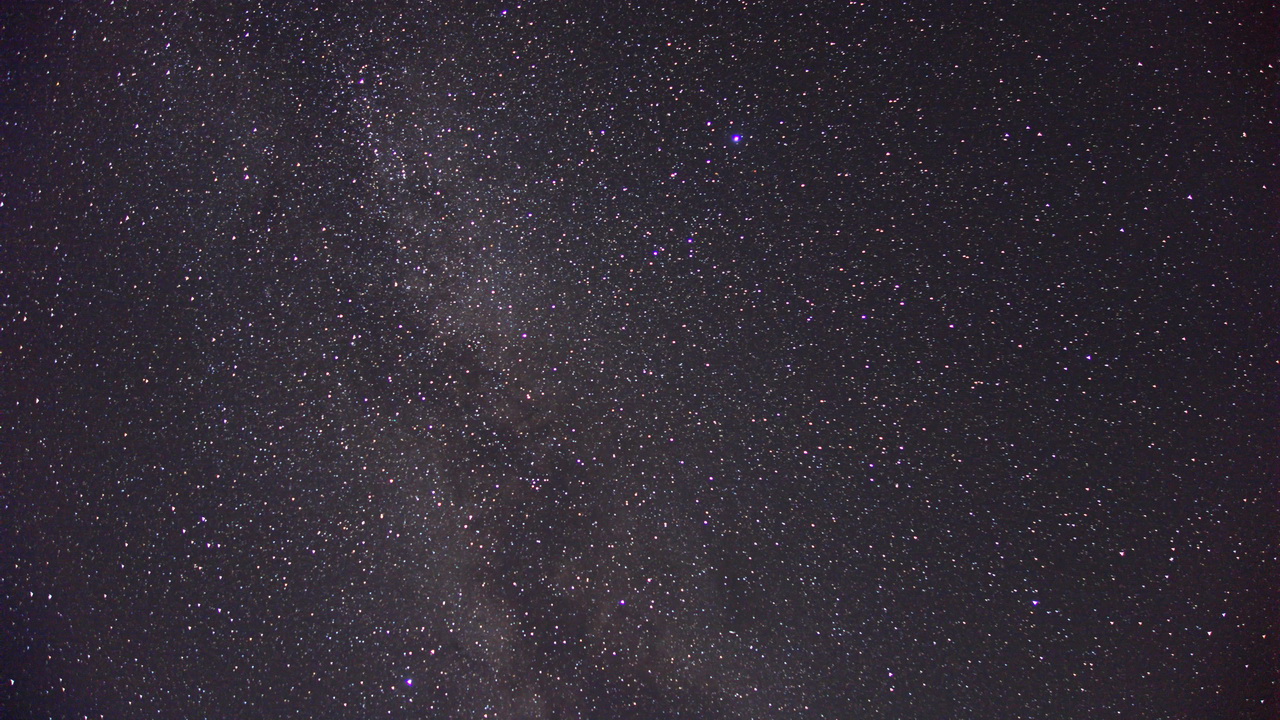
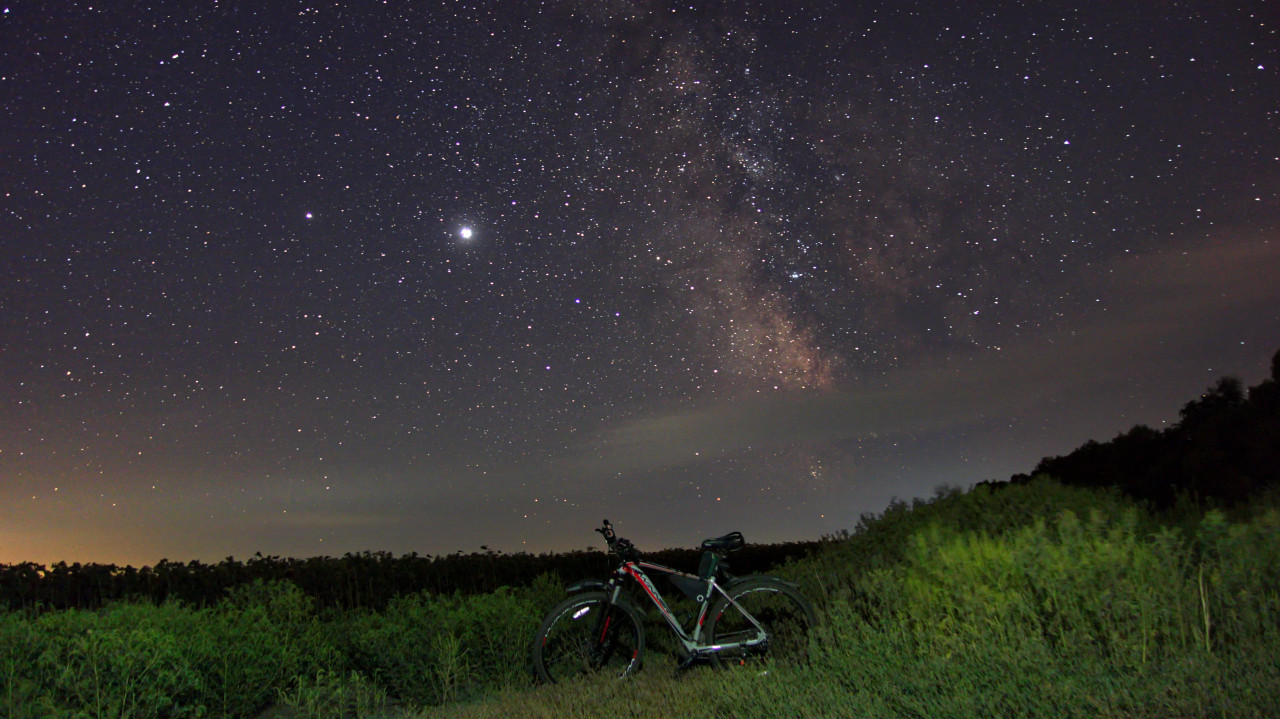
The best shot was my bicycle against the background of the stars. Since it was very dark in the field, I had to carefully illuminate the bike and the surrounding landscape with a flashlight so it would be clearly visible. It turned out unexpectedly beautiful: this photo became one of my favorites. For it, I took about 14 frames with a long exposure (15 seconds), which I later stacked in the Sequator program.
I didn’t plan to stay long: it was already midnight, the Moon had risen on the horizon, and a workday awaited tomorrow. Plus, I had to get home — about 19 kilometers, totaling 38 km round trip. For an evening ride, that’s perfectly fine: in other words, I managed to combine the pleasant with the useful.
I am very pleased with the observations. It was amazing. It felt a little creepy realizing you are alone in a field, with no one and nothing around — just the stars.