Saturn
Saturn is perhaps the most beautiful planet in our Solar System. Its famous rings immediately catch the eye and are unforgettable. It’s no surprise that among astronomy enthusiasts, it is one of the most sought-after objects for observation.
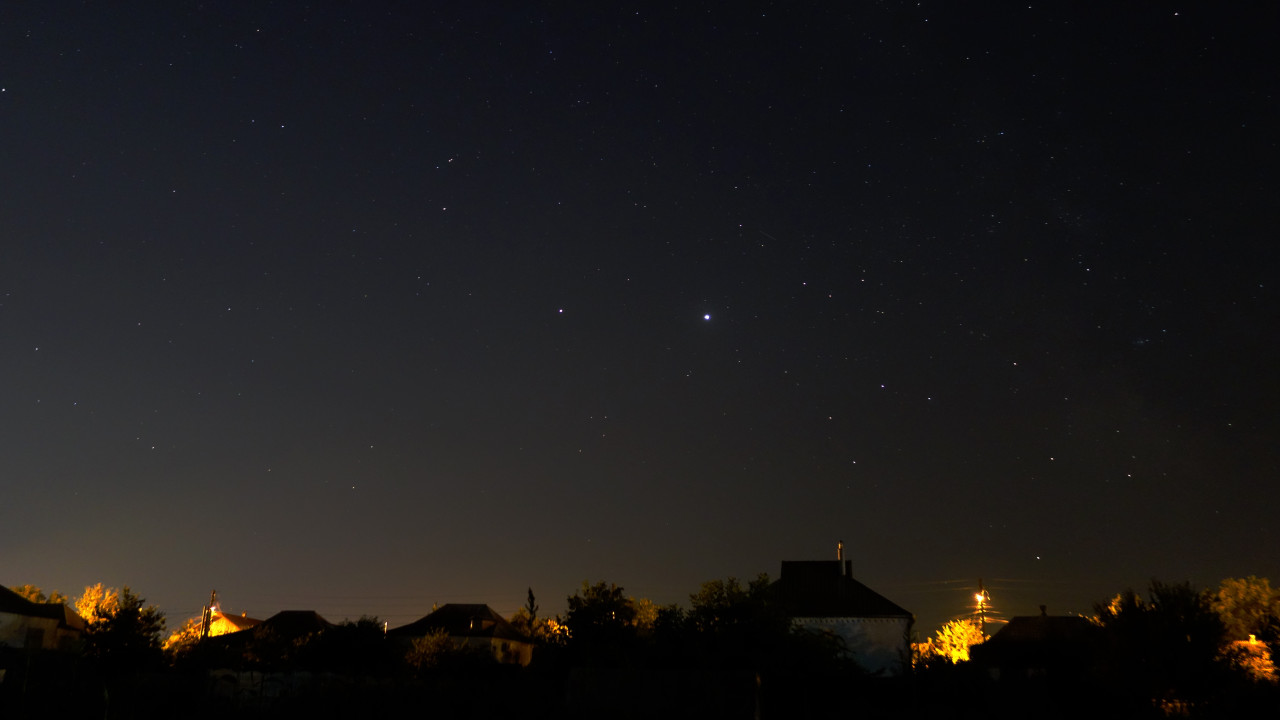
Finding Saturn in the sky is not difficult at all. It appears as a fairly bright yellowish “star” — its magnitude usually stays around 0–1. Of course, compared to dazzling Venus or bright Jupiter, it doesn’t stand out as much, but if you roughly know where to look, it’s easy to spot. Even with a good pair of binoculars at 16–20× magnification, you can already make out the planet’s disk and a hint of the famous rings.
I first observed Saturn back in 1999 — through a homemade telescope assembled literally from eyeglass lenses. I was just scanning bright stars and accidentally stumbled upon it. Even with such simple optics, the tiny rings around the planet made a huge impression.
In size, Saturn is almost 9.5 times larger than Earth — only slightly smaller than Jupiter. But it is located roughly 9.5 times farther from the Sun than Earth. Because of this, the visible diameter of the planet itself is only about 17–18 arcseconds, but together with the rings — around 40”. That’s more than enough to see not just a dot, but a real planet with rings in a small telescope or a quality pair of binoculars.
Saturn completes one orbit around the Sun in 29.5 Earth years. That’s why it moves slowly across our sky — much more calmly than Jupiter or Mars. The best time to observe it is during oppositions: they occur roughly every 13 months and shift about two weeks later each year. But even outside of opposition, the distance to Saturn doesn’t change dramatically, and the planet remains observable for almost the entire year. That makes Saturn one of the most “convenient” objects for amateur astronomers.
In 2020, observing conditions for Saturn in Dnipro were far from ideal. The planet was in Capricornus and rose only 15–20° above the horizon. Because of this, the atmosphere introduced strong distortions for such low objects: the image would “swim” and lose sharpness. Observing and photographing under these conditions becomes challenging, and you have to wait for the moment when the planet rises as high as possible above the horizon.
However, during that period, Saturn’s rings were well opened — almost 24°, which made them look especially spectacular. They consist of billions of ice particles, dust, and small rocks, and at a good inclination, this delicate structure creates a truly stunning view. In the coming years, the tilt of the rings will gradually decrease, and in a few years they will become noticeably less expressive.
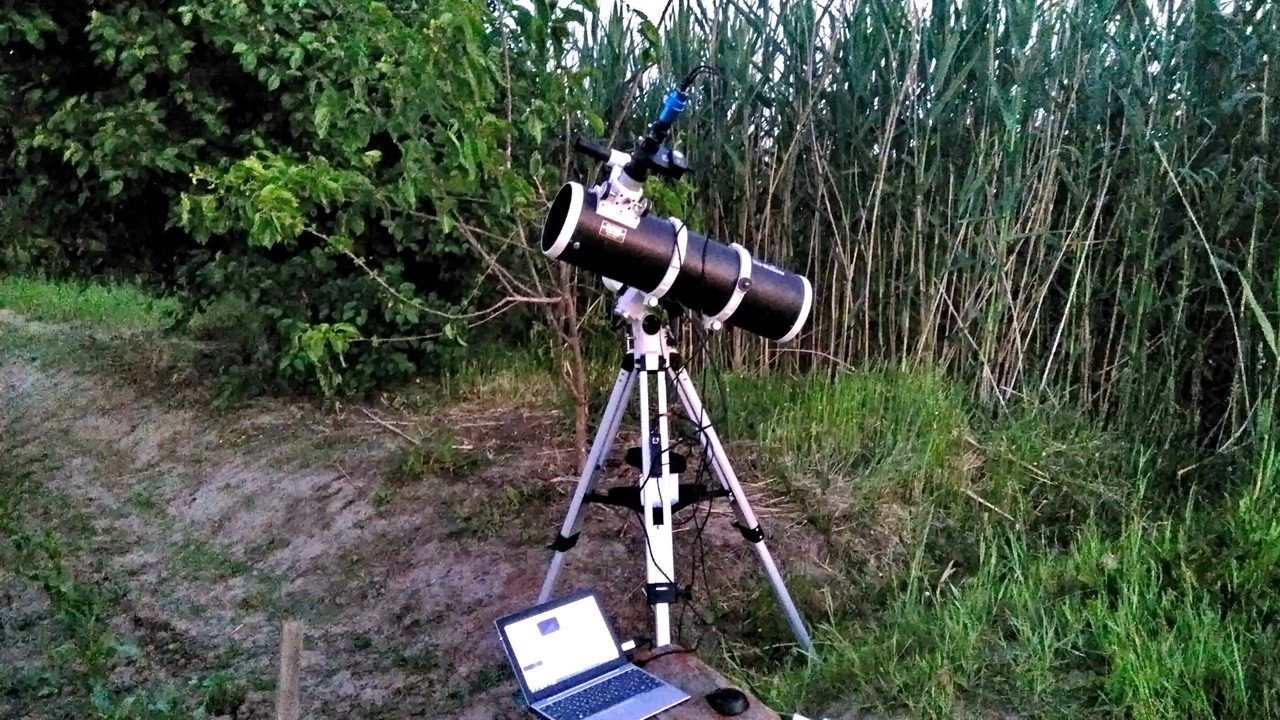
I managed to take several successful photos of Saturn using the QHY5III178m monochrome astro-camera. Observations were done in the garden, and I had to choose spots far from buildings, as they act as additional sources of atmospheric distortion.
The summer shot turned out to be the best at that time. The night was exceptionally steady — the atmosphere barely trembled. The Cassini Division, which separates the main rings, is clearly visible in the frame, and the cloud belts on the planet’s disk are well defined. On Saturn they are not as contrasting and bright as on Jupiter, but several belts are still noticeable. By the way, a day on Saturn passes very quickly — only about 10 hours and 33 minutes.
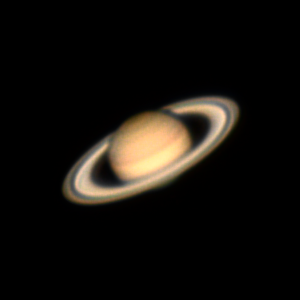
| Date | 18-06-2020 |
| Time | 3:14 |
| Elongation | 146.4° |
| Phase | 99.9% |
| Diameter | 17.5” |
| Altitude | 21.4° |
This shot was taken already in autumn. The atmosphere was noticeably worse, and the image lost some detail. Here you can see the reduction in the apparent size of the planet and its rings, as the distance between Earth and Saturn increased. The Cassini Division is still faintly visible but not as sharp, and the cloud belts partially merge. This is a clear example of how much the Earth’s atmosphere can “spoil” the view. Unfortunately, there’s nothing we can do about it — we just have to wait for a good night.
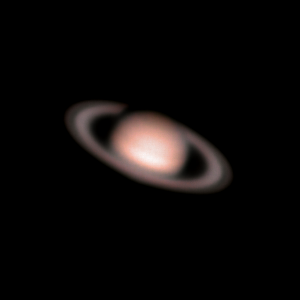
| Date | 05-10-2020 |
| Time | 19:42 |
| Elongation | 102.5° |
| Phase | 99.8% |
| Diameter | 17.1” |
| Altitude | 20.1° |
With each passing year, Saturn will rise higher above the horizon in our latitudes. However, as I mentioned earlier, due to Saturn’s fairly long orbital period around the Sun, this process will happen slowly.
Nevertheless, both frames perfectly convey the very feeling you get when observing this amazing planet in real life.