Jupiter
Jupiter is one of the most popular and easiest planets to observe. It stands out brightly in the night sky, with its magnitude reaching up to –2.9, making it very easy to find. Almost any optical instrument will do for observation: even in a small spyglass or binoculars, you can already see the four largest moons — Io, Europa, Ganymede, and Callisto, which were discovered by Galileo back in 1610.
Jupiter is the largest planet in the Solar System. Its diameter is about 142,984 km, which is 11.2 times larger than Earth's diameter. It orbits at an average distance of about 5.2 AU (778 million km) from the Sun — roughly five times farther than Earth. Even with an amateur telescope, you can see cloud bands on Jupiter’s disk, and sometimes the Great Red Spot — a gigantic anticyclone larger in diameter than Earth itself. Thanks to these features, Jupiter is considered one of the most beautiful and fascinating targets for both visual observation and astrophotography. I observed Jupiter as far back as 1999 through a homemade telescope made from eyeglass lenses, which gave no more than 20× magnification. It was the first planet I ever discovered, back when I barely understood the night sky.
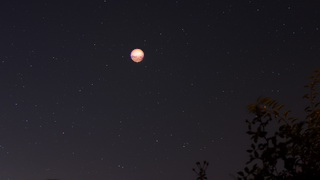
As I mentioned earlier, finding Jupiter in the sky is not difficult. It outshines every star, second only to Venus, which glows with a pure white light in the morning or evening. Jupiter has a slightly pinkish hue and can shine all night long. The best time to observe Jupiter is during opposition periods — when Earth and Jupiter are aligned on the same side of the Sun, minimizing the distance between us. During these periods, Jupiter reaches its maximum apparent size of about 45–50 arcseconds and is visible all night. However, it can be observed at other times too — the distance will simply be greater, and the apparent diameter smaller (around 30–35 arcseconds), but since Jupiter is inherently large, this is still sufficient. It is only invisible during conjunctions with the Sun — when Jupiter is on the far side of the Sun. These periods usually last about 1–2 months.
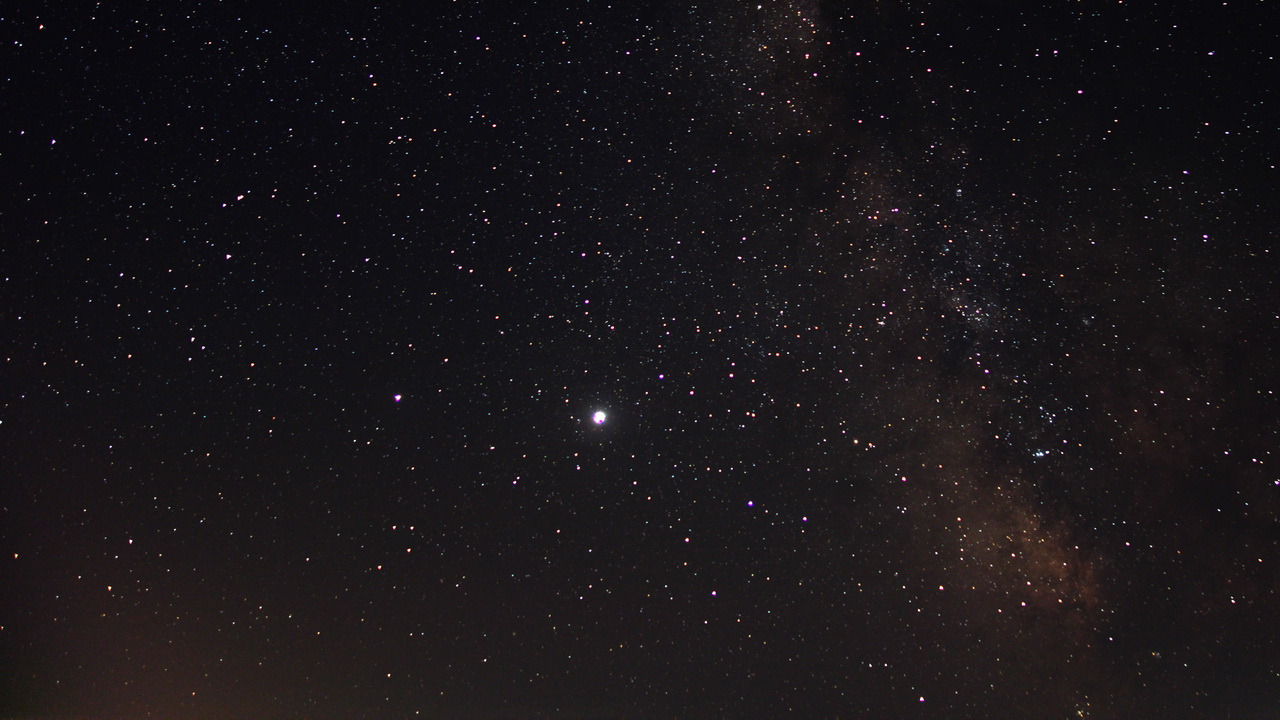
One Jovian year lasts almost 11.86 Earth years, so opposition periods shift roughly one month later each year, and Jupiter moves relatively quickly among the stars — it transitions from one zodiac constellation to another annually. Unfortunately, in 2020 the observing conditions for Jupiter in Ukraine were far from ideal. The planet was in Sagittarius, and its altitude above the horizon never exceeded 18–20°. Because of this, dense atmospheric layers caused significant distortion: the image trembled and fine details were lost. The best observing window was during the summer months, but the visibility period was relatively short. In the following years the situation will improve — the planet will gradually move into more northerly constellations, and viewing conditions will become much better.
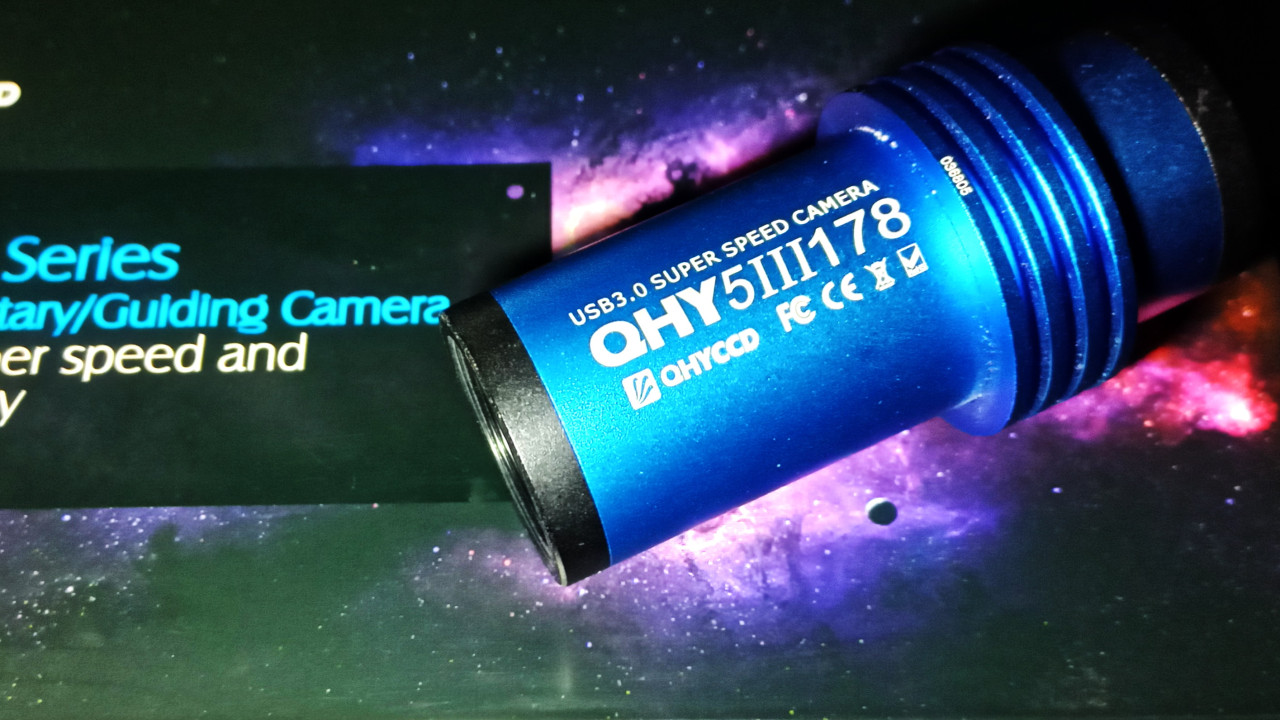
Nevertheless, this did not prevent me from taking photographs of Jupiter. I captured several images using a monochrome astro-camera QHY5III178m and a ZWO EFW Mini filter wheel. This filter wheel allows color images to be created from a monochrome sensor by photographing the planet through different filters — red, green, and blue. All this equipment connects to a Windows tablet-transformer used for recording. The imaging process is not overly complicated, but it involves several important nuances.
The reason is that a day on Jupiter lasts only about 9 hours 55 minutes, making it the fastest-rotating planet in the Solar System. Visually through a telescope this rotation is not noticeable, but in photographs taken even a few minutes apart it becomes obvious. Because of Jupiter’s rapid rotation, you cannot record very long sequences of frames — otherwise details become smeared. To compensate for the rotation during processing, special software such as WinJUPOS is used, which correctly aligns the images and produces a final high-resolution color photograph.
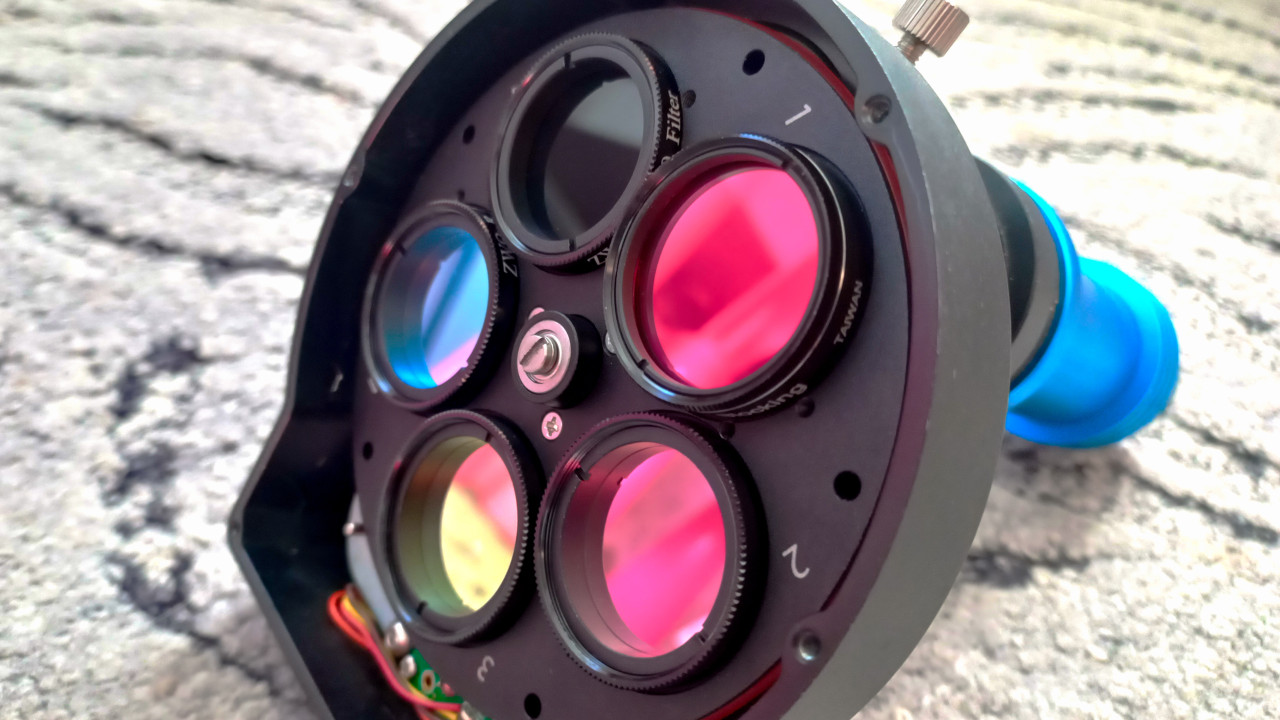
The imaging sessions took place in the vegetable garden, far from houses and buildings that obstruct observation. This required running a very long cable across the entire garden. And the garden has its own atmosphere — an incredible number of mosquitoes, hedgehogs, and high humidity that causes dew to form on all the equipment, which can halt observations. Still, I managed to capture a couple of good frames.
Jupiter is a gas giant and consists entirely of gas — mainly hydrogen (about 90%) and helium (about 10%), with small amounts of methane, ammonia, water vapor, and other compounds. It has no solid surface like the terrestrial planets. When we look at Jupiter, we see only the upper cloud layers that envelop the entire planet. The uppermost clouds are mostly ammonia ice crystals, below them ammonium hydrosulfide (NH4SH), and deeper still there may be water clouds. Extremely strong winds blow on Jupiter (up to 600 km/h and more), dividing the clouds into distinct belts and zones with different colors — from white and yellow to brown and reddish. Powerful vortices form between the cloud belts because neighboring belts move at different speeds.
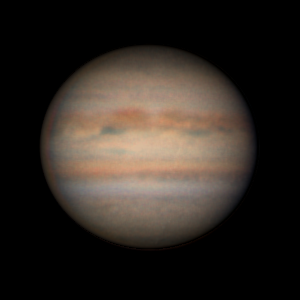
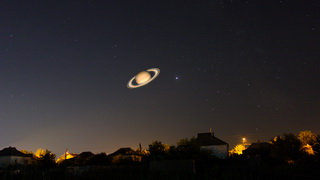
| Date | 18-06-2020 |
| Time | 2:27 |
| Elongation | 151.8° |
| Phase | 99.8% |
| Diameter | 46.4” |
| Altitude | 20.2° |
One of these vortices is the Great Red Spot. It is a gigantic, long-lived anticyclone — a high-pressure vortex that rotates counterclockwise and has existed at least since the 17th century, possibly much longer. In 2020 its size was roughly 15–16 thousand km across — slightly larger than Earth’s diameter. It was not visible in the first photograph because it was on the opposite side of the planet. To see it, you have to wait for the moment when that particular side rotates into view. The Great Red Spot is clearly visible even in a small telescope, and in photographs it stands out especially brightly with its reddish color against the cloud bands. The color of the spot is linked to chemical reactions in the upper cloud layers; it appears as a huge oval in the planet’s southern hemisphere.
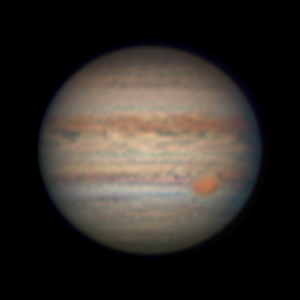
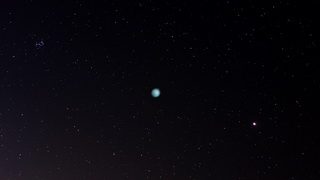
| Date | 27-06-2020 |
| Time | 2:36 |
| Elongation | 161.3° |
| Phase | 99.9% |
| Diameter | 47.00” |
| Altitude | 19.6° |
Photographing such a dynamic planet as Jupiter with a monochrome astro-camera is still not very convenient. To obtain a high-quality image, you need to capture several short sequences through each filter (2–3 minutes each) and then carefully align them. This generates large amounts of data, is quite labor-intensive, and requires significant processing time. Color cameras are much more convenient in this regard: the entire RGB dataset is captured in one short video without any channel alignment issues. Unless the goal is to image Jupiter in narrow spectral bands (for example, to isolate specific cloud layers), a color camera is the best choice for most amateurs.
Interestingly, more than 20 years have passed since I first saw Jupiter through a homemade telescope made from a roll of wallpaper and eyeglass lenses. Now it is possible to obtain excellent detailed photographs of this planet. Astrophotography reveals far more of a telescope’s potential than visual observing alone. Jupiter never ceases to amaze with its beauty and constant dynamism — its atmosphere changes literally before your eyes. Besides static images, there is still plenty to capture: animations of the planet’s rotation, the motion of its moons, and even eclipses and shadow transits on Jupiter. So there is still plenty of work to do…