Moon
Observing the Moon is a win-win option for astronomy enthusiasts regardless of the equipment used. The Moon always looks impressive, it's available almost every night, and allows you to examine its surface in the tiniest details. That's why I have accumulated a large number of Moon photos taken at different times and with various equipment. This time I decided to capture the Moon using the planetary astro camera QHY5III178M to obtain images with high detail and quality.
On the night of August 8–9, 2020, the Moon was in the waning gibbous phase with about 74% illumination and rose to a sufficient altitude above the horizon — over 40°. This is arguably the ideal phase for observation and imaging: the lunar surface is bright enough to reveal details of craters, seas, and mountains, while shadows still emphasize the relief, making craters particularly expressive. The weather cooperated as well, allowing sharp images to be obtained. Imaging time was around 5 a.m. local time.
Since there aren't many color details on the lunar surface, the images are practically black-and-white anyway. Therefore, imaging was done using a red light filter, which helps reduce the effects of atmospheric turbulence and increases the contrast of surface details. For each area, 300–500 frames were recorded at 3–4 frames per second, with exposures of 10–12 ms, gain at 49%, and histogram fill in the range of 46–63%. After that, the best frames were selected for further processing. The processed photos were then tinted in warm golden tones for a more striking effect.
First photo covers the northern part of the Moon. Here you can clearly see large craters: Archimedes with its smooth floor, Aristillus with bright radial rays, and Posidonius, partially hidden in shadow. Also interesting is the crater Cassini, whose basin is so large that it contains several smaller craters within it. Overall, the area is particularly attractive due to the combination of vast mare plains and sharp mountain ranges.
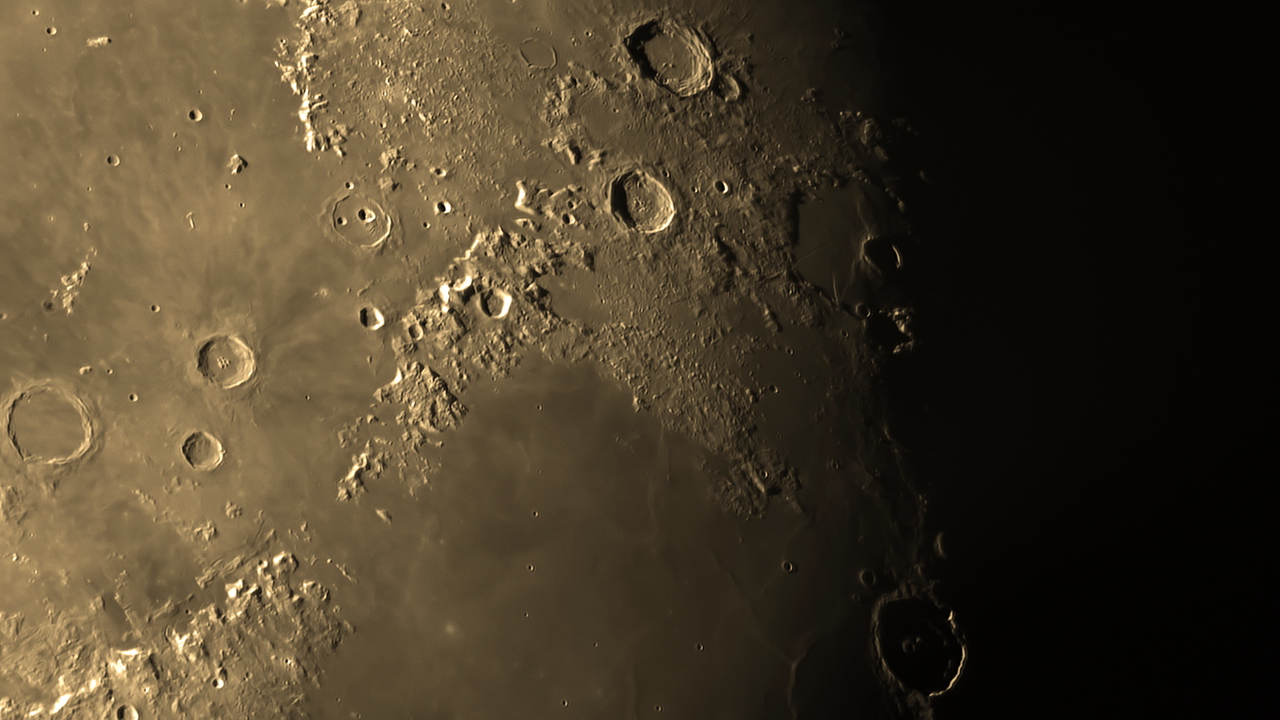
Separately worth noting is that the frame also captured the landing site of the Apollo 15 mission (1971), located at the foot of the Apennine Mountains near the crater Archimedes. Of course, it's impossible to see the traces of the expedition in the image — that would require completely different resolution — but the very thought that astronauts once worked right here adds special significance to the observation.
The Apollo 15 mission launched on July 26, 1971, and became the fourth human landing on the Moon. Unlike previous expeditions, the main focus was on scientific research. The crew consisting of David Scott, Alfred Worden, and James Irwin landed in the Hadley–Apennine region, at the foot of the Apennine Mountains near Hadley Rille. This region was chosen due to its interesting combination of mountainous terrain and ancient lava flows.
For the first time, astronauts used the Lunar Roving Vehicle, which allowed them to travel significant distances and collect over 75 kg of soil and rock samples. Apollo 15 is considered one of the most successful scientific expeditions to the Moon — the mission made a significant contribution to understanding the geological history of the Moon.
Second photo shows the central part of the Moon. Here stand out the massive craters Albategnius and Hipparchus. Against the background of their ancient and partially destroyed walls, the small but bright crater Dionysius with distinct rays extending for tens of kilometers looks particularly contrasting. Nearby you can see the crater Agrippa with a sharp rim and dark floor, as well as the crater Godin, which stands out for its relatively small size but sharply defined walls.
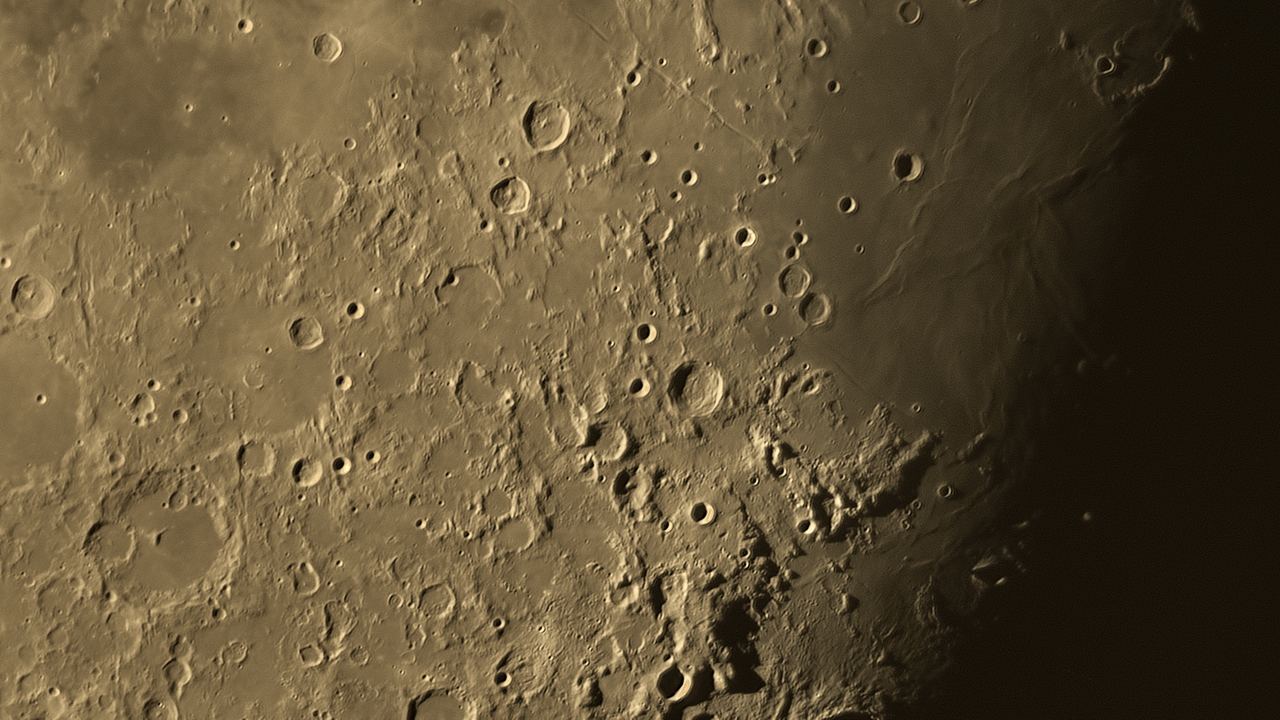
Third photo covers the southern part of the Moon. Here the famous "trio" of craters attracts attention — Theophilus, Cyrillus, and Catharina. Their sequential arrangement clearly shows the difference in age: from the relatively young Theophilus with sharp walls to the much older and eroded Catharina. To the west of them lies the large crater Sacrobosco with a fractured floor, as well as smaller formations such as Werner and Aliacensis, forming characteristic groups.
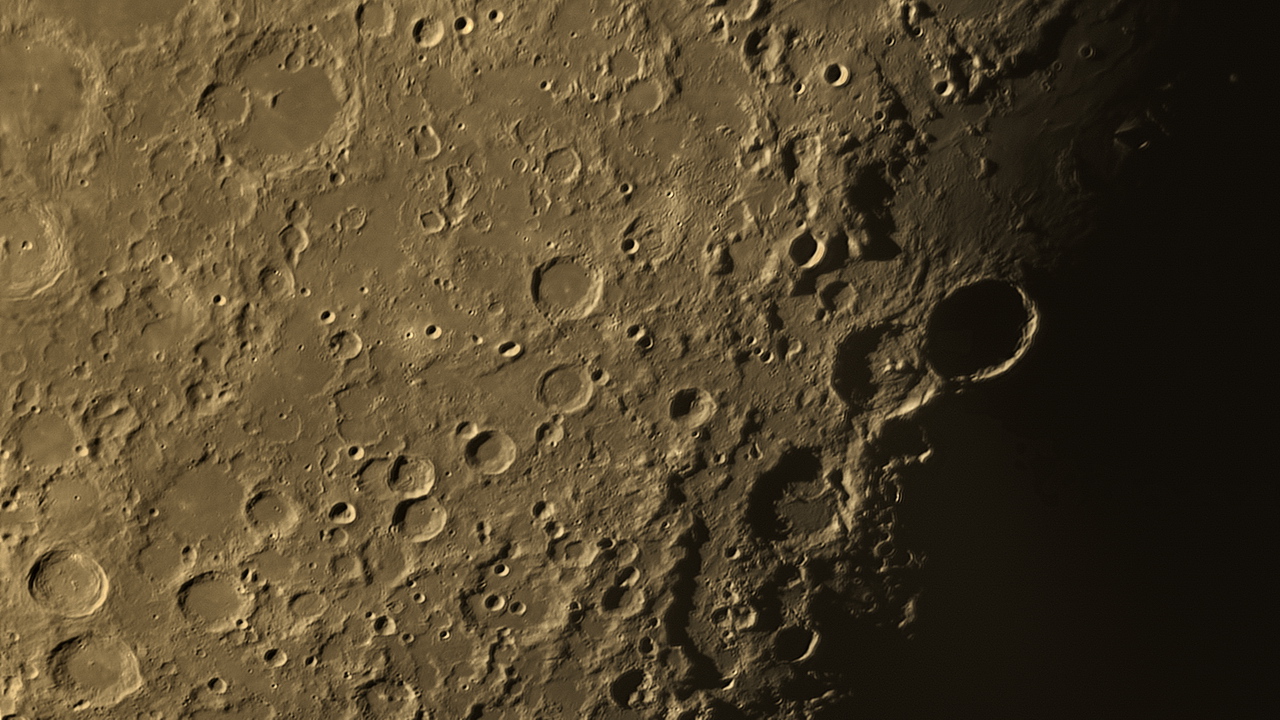
Fourth photo also focuses on the southern part of the Moon, in the region of the south pole, where there are especially many craters. Here stand out Stofler and Maurolycus. They represent ancient, heavily degraded formations with multilayered walls and complex internal structure. Nearby are the craters Faraday and Zagut, which partially overlap each other, demonstrating centuries of impact history. Deep shadows in this area particularly emphasize the relief and give a strong sense of three-dimensionality.
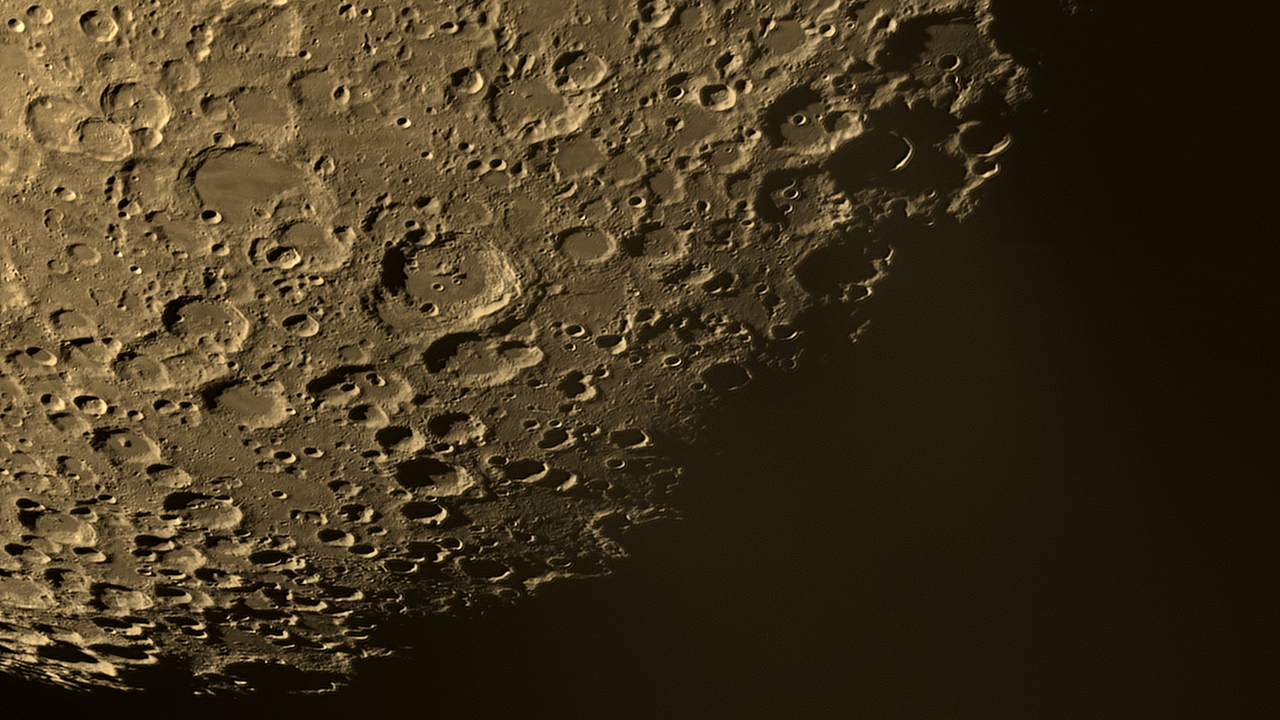
The photos turned out excellent, and I'm more than satisfied with the result. Imaging the Moon remains one of the most accessible and fascinating areas of astrophotography. Even with relatively compact equipment, it's possible to obtain high-quality images that allow studying the lunar relief in all its detail. Each phase reveals new areas and new combinations of light and shadow, meaning the interest in this celestial object never fades.