Uranus
After observing the main planets of the Solar System and gaining some experience in astrophotography, I decided to move on to a more challenging task — observing and photographing Uranus. However, Uranus is not among the popular targets for amateur astronomers due to its faint appearance and very significant distance.
Uranus is the seventh planet from the Sun, discovered by William Herschel in 1781 using a telescope. It is located roughly twice as far from the Sun as Saturn, and 1.7–2 times farther from Earth depending on the relative positions of the planets. Uranus has a diameter of about 51,118 km — almost 4 times larger than Earth's diameter, but approximately 2.4 times smaller than Saturn's (120,536 km without rings). These factors result in very small angular size of Uranus in the sky — about 3.5–3.7 arcseconds in 2020 — and low brightness (apparent magnitude around +5.7 during the observation period). This makes the planet visible only through binoculars or a small telescope. Finding Uranus in the sky is significantly more difficult, especially under urban light pollution and in poor seeing conditions.
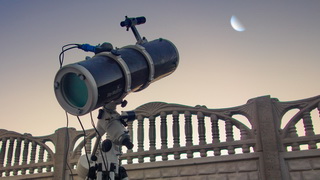
Still, I decided to give it a try. Although I wasn't expecting spectacular results, my SkyWatcher BKP 150/750 telescope with a Celestron X-Cel LX 5 mm eyepiece (giving about 150× magnification) gave me hope for a successful observation.
In August 2020 Uranus was located in the constellation Aries, which served as a convenient reference point. Under urban light pollution it is impossible to see the planet with the naked eye. For the search I printed star charts with Uranus's position marked and tied to bright stars. Then I systematically moved from these reference stars using the telescope's finder, memorizing characteristic star patterns and constantly checking against the map. This is the standard method for finding faint objects.
The difficulty was that the finder scope gives an upside-down image, and controlling the equatorial axes of the telescope doesn't always intuitively correspond to "up-down" or "left-right" directions. This requires a lot of patience and attention, especially when both the planet and the reference stars are very faint. But it is exactly this painstaking search that turns observing Uranus into a real adventure for an amateur astronomer.
Here is a fragment of the night sky in the region of the constellations Taurus, Aries and Pisces. Uranus is in the center of the frame (click the icon to see the labels).
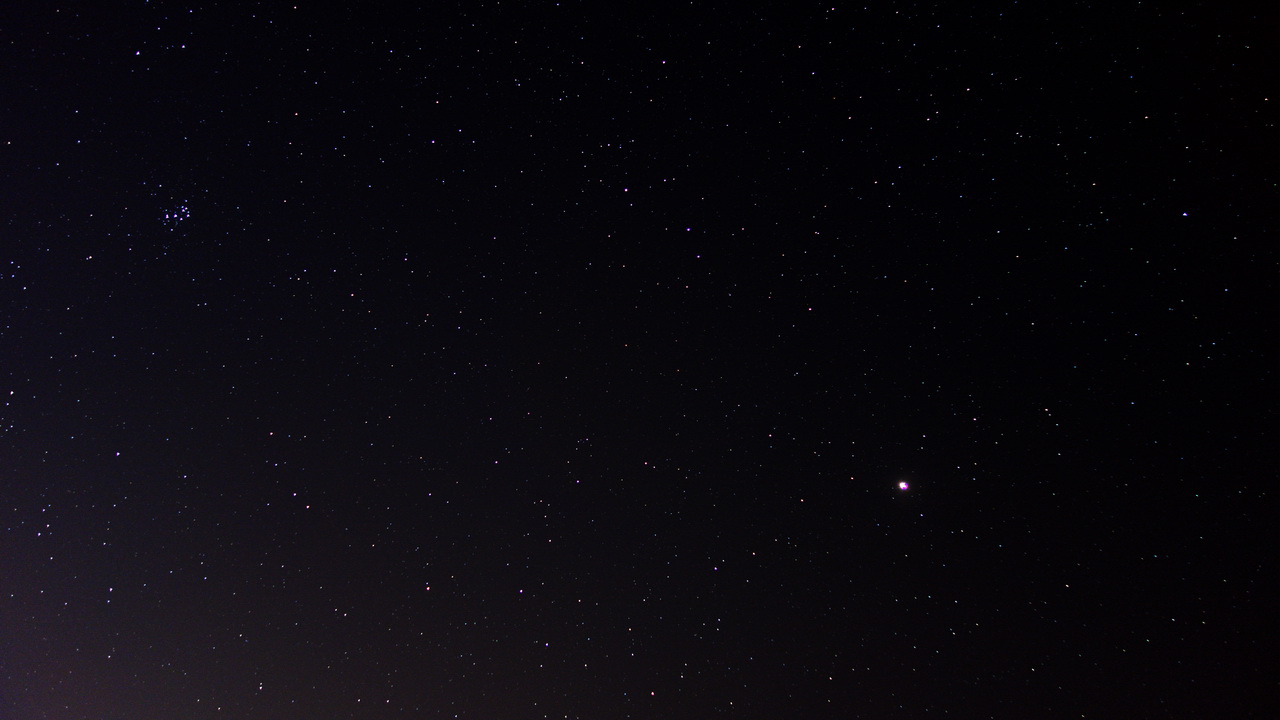
It is immediately noticeable how much Uranus blends in with thousands of faint stars, most of which are completely invisible to the naked eye under urban light pollution. For comparison — bright Mars, which is located nearby, literally doesn't need to be searched for.
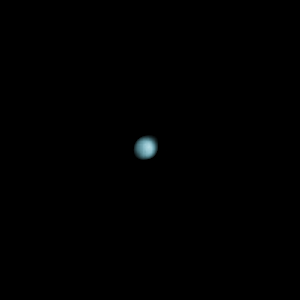
After about 15 minutes of searching I finally managed to point the telescope at Uranus. Unlike stars, the planet stood out with its characteristic turquoise-cyan hue. At 150× magnification a tiny turquoise disk was visible in the eyepiece. Of course such magnification is not enough for any serious detail — the angular size of ~3.6″ is too small. Increasing magnification further made no sense because atmospheric turbulence and the limitations of the telescope would not allow seeing more detail.
I also tried to photograph Uranus using the QHY5III178m astronomy camera. Setting up the imaging turned out to be much more difficult than for the other planets. The low brightness of Uranus made pointing difficult, mounting the camera always shifted the focus, and I had to roughly re-adjust the telescope intuitively. Selecting exposure and focus parameters also took a lot of time. But in the end I managed to point the camera and take a picture. Of course expecting any detail from a 150 mm telescope would be naive, but the very fact of capturing Uranus's disk was already an achievement.
| Date | 24-08-2020 |
| Time | 2:38 |
| Elongation | 110.6° |
| Phase | 99.9% |
| Diameter | 3.6” |
| Altitude | 45.4° |
In the image Uranus looks like a tiny turquoise ball without any visible surface details or rings, but the very fact of photographing the planet adds special value to the observation. For significantly better results you need a telescope with 200–250 mm aperture and much darker skies. This experience inspired me to continue experimenting with even more distant objects such as Neptune and to keep improving my equipment.
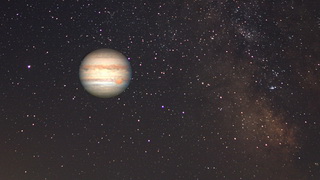
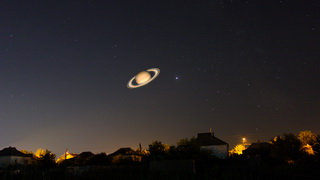
Compared to bright planets such as Jupiter or Saturn, Uranus requires far more patience. While even a small telescope shows Jupiter as a bright disk with belts, Uranus is just a tiny pea, barely distinguishable as a disk. This really emphasizes that astronomy is a hobby that values not only spectacular views, but also the process of overcoming difficulties. The journey itself.