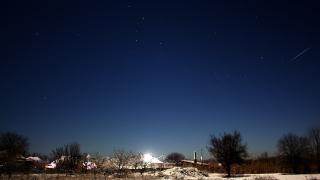
Perseids 2021
A year after the successful trip out of town to the so-called “Starry Meadow” for observing the Perseids, I decided to repeat the experience. Back then, everything went wonderfully: a sea of stars, relative silence, and plenty of meteors. The evening bike ride itself turned out to be very enjoyable. The conditions in 2021 promised to be no worse...
This time, I also brought along equipment for photography. But instead of the compact Sony DSC RX-100, I took the DSLR camera Canon EOS 550D with the kit lens 18–55 mm. It was interesting to compare the results and see how the Canon would handle the night sky here.
Even on the way, while riding my bike, I managed to spot several meteors — that really lifted my spirits. When I arrived at the spot, the show unfolded in all its glory. As last time, the activity was uneven, with periodic bursts and lulls.
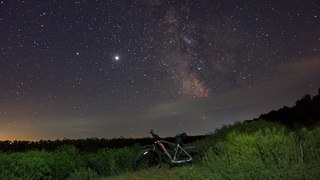
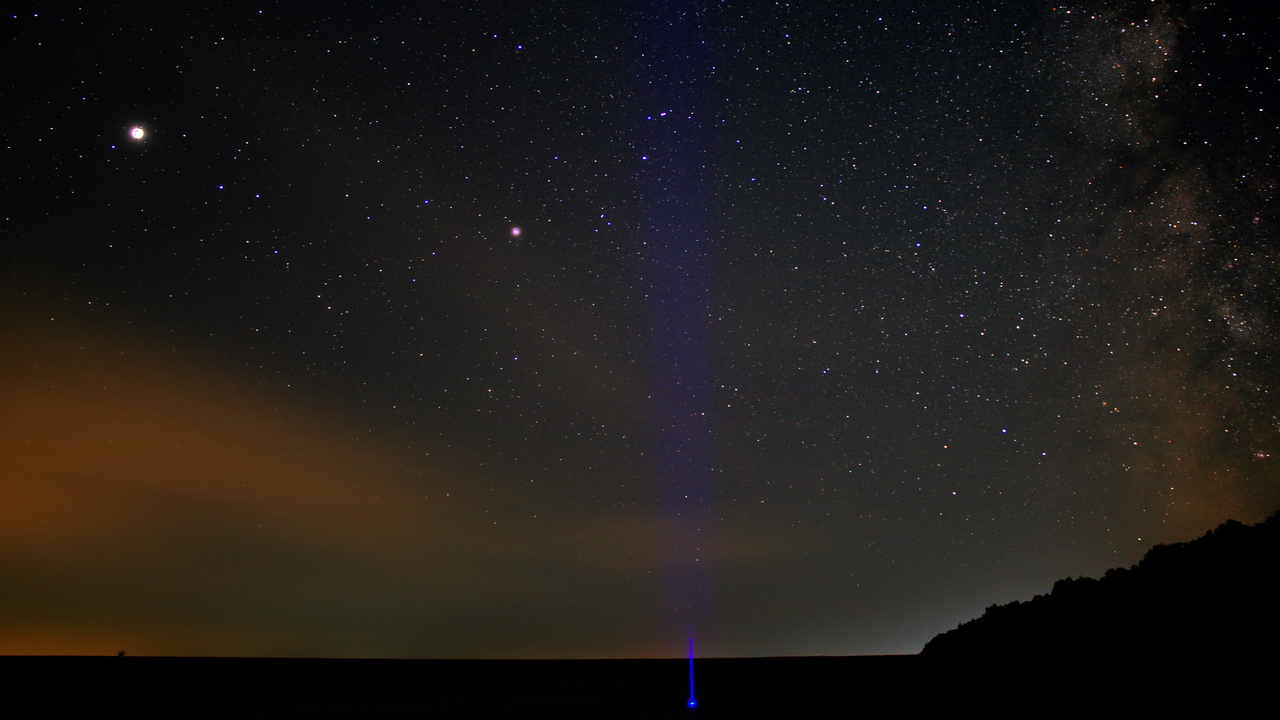
I reached the “Starry Meadow” just as the Moon was setting; its phase was small. Here’s the first shot: the view is good, but thin clouds slightly intensified the light pollution from nearby settlements, just like last year. Jupiter and Saturn are visible in the sky, now positioned much farther apart from each other. This time, I decided to capture a blue flashlight pointed at the sky. It didn’t turn out as spectacular as last time with the laser and the bike, but still interesting.
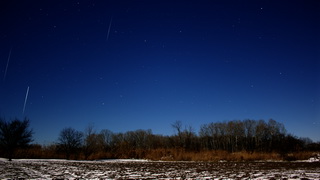
Over the observation period — about an hour and a half — I managed to see around 50–60 meteors of varying brightness; I didn’t count exactly. About five of them I spotted on the way, and at the meadow itself — about a dozen bright ones, including three very bright. Overall, the result was similar to last year’s.
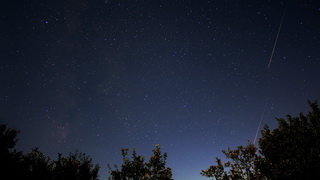
Here’s another shot of the starry sky. Of course, without landscape elements, the photos seem less expressive, but even the silhouettes of trees in the dark add atmosphere.
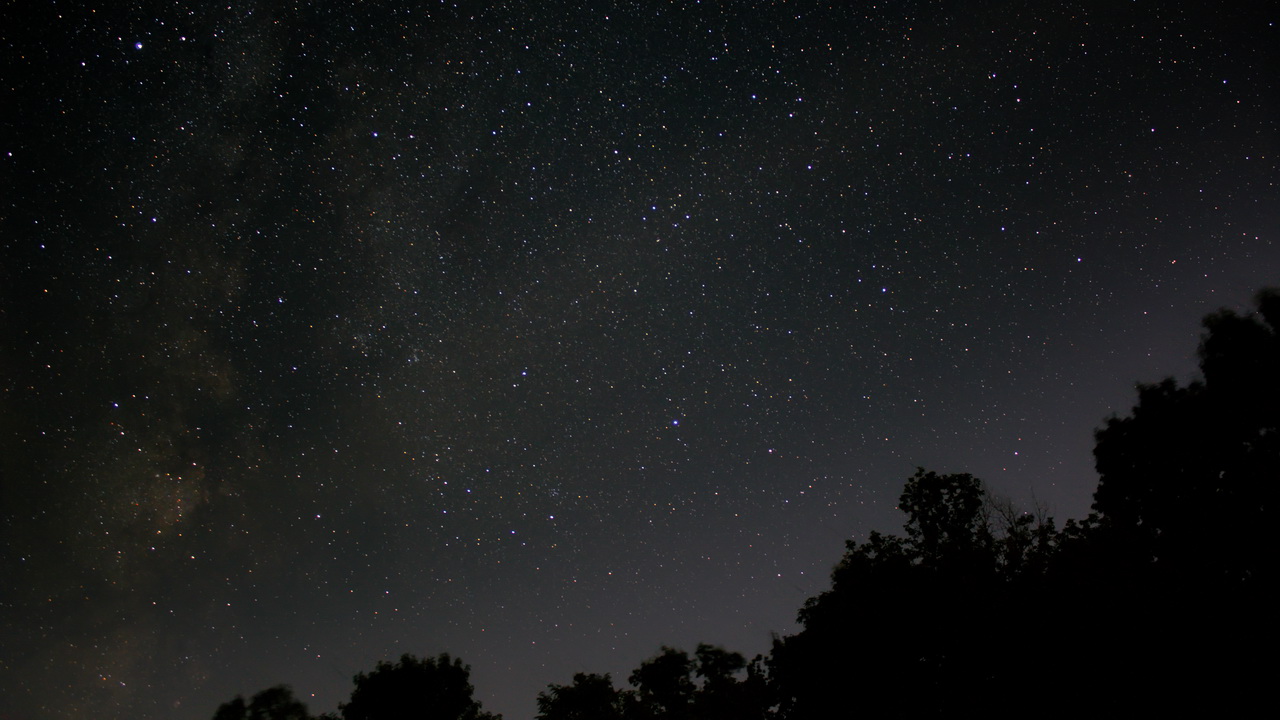
I didn’t take many frames. Overall, the result is decent, though the Sony gives a more saturated image. But the Canon has an important advantage — the ability for long continuous shooting, which is much more convenient. As practice showed, for a quality result, you need to take at least 50 frames of the starry sky for subsequent stacking in Sequator.
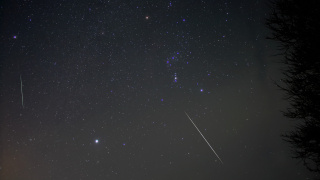
Another interesting frame — from a different part of the sky, without the Milky Way, but with the Big Dipper. And completely unexpectedly, during the shooting, a very bright and slow meteor flew by there, scattering sparks. It looked so unusual that I first thought it was a firework. Fortunately, it made it into the frame! Combining the shots while preserving the meteor trail proved tricky, but the result was striking: the meteor literally “pierced” the handle of the Big Dipper’s ladle.
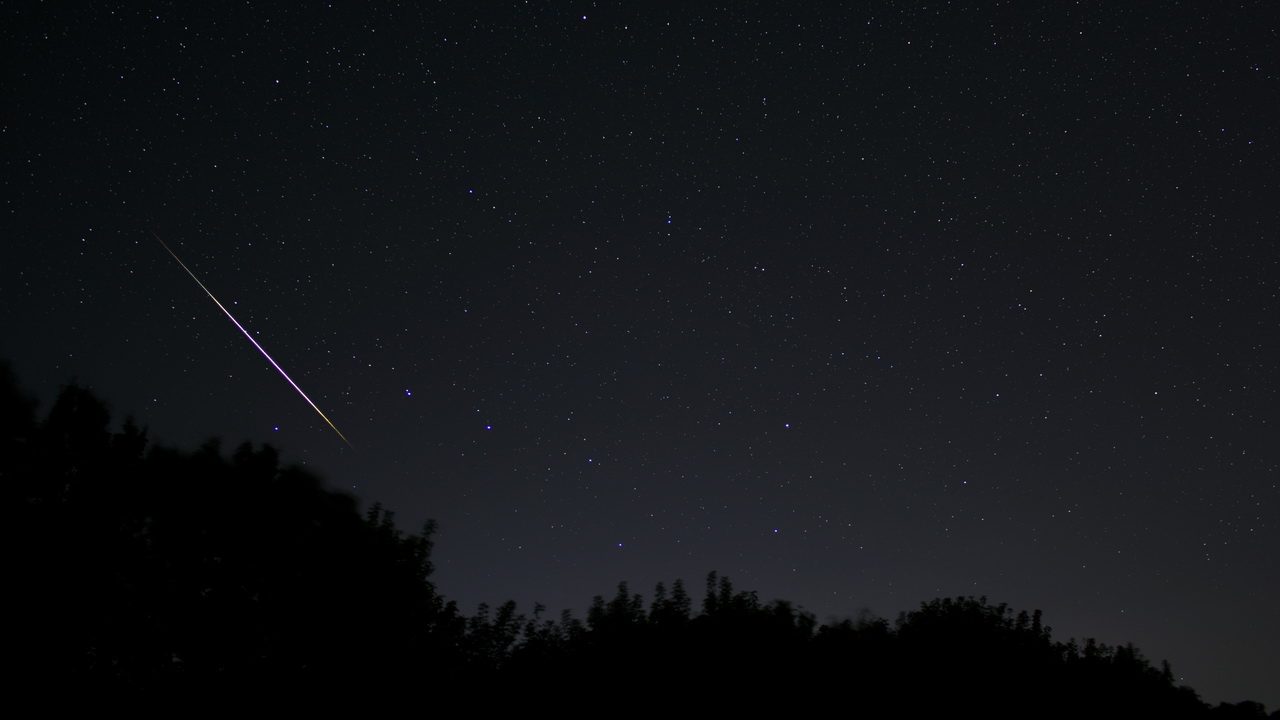
When trying to study the flight trajectory, it turned out that it pointed toward the constellation Capricorn, not Perseus. This means the object does not belong to the Perseid stream. Its appearance also suggests this: slow, reddish-orange, with sparks and fragmentation. Most likely, it was a meteor from the alpha-Capricornids (α-Capricornids) stream. This stream is active from July 3 to August 15 (peak on July 30) and is known for producing few but bright and slow fireballs, often breaking up into sparks. That’s exactly the spectacle captured in the photo.
Closer to 1 a.m., it was time to head home — almost 20 kilometers of road lay ahead. On the way, I stopped briefly near the highway in the Taromske area. But unfortunately, the sky there was far less impressive: just a few kilometers from the Starry Meadow, the light from street lamps already greatly interfered with observations. This once again confirmed that the chosen spot was truly successful: quiet, dark, and with an excellent view.
Unfortunately, this observation turned out to be the last one at the “Starry Meadow.” In subsequent years, I observed the Perseids under different conditions:
- 2022 — observations from home (full moon)
- 2023 — a meadow in the Yasny settlement
- 2024 — from home
- 2025 — from home (Moon in a large phase)
But it was here, at the meadow, that the impressions were the strongest. Sometimes it got a bit eerie — after all, it’s an open field, silence, and not a soul around — but the sense of the sky’s vastness and the proximity of space was simply incredible!