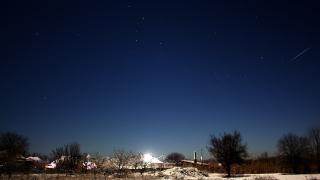
Geminids 2025
This year, I once again managed to observe the meteor shower Geminids — fortunately, the weather allowed it and didn’t interfere too much with the observations. It was quite an exceptional case, because for almost an entire month, it was impossible to even see the Sun — only briefly. The rest of the time, the whole month was cloudy: the sky was densely covered with clouds, it rained, there was fog and drizzle. In general, typical late autumn to early winter weather for our region, and December is usually the cloudiest month of the year here.
But on this day, the weather was, one might say, kind: a light frost of −1 °C set in, and a strong wind dispersed the clouds as early as the morning. The weather was very unstable — clouds would disappear and then reappear — but nonetheless, it inspired optimism.
By evening, the wind died down, and the sky cleared completely. As early as 9 p.m., the first meteor could be seen, streaking through one of the brightest winter sky constellations — Orion.
I started observing after 10 p.m., although I had originally planned to watch after midnight. The thing is, in the evening, even on the outskirts of the city, there’s quite a lot of light pollution from street lamps, which greatly interferes with observations. After midnight, they turn it off. But I still decided to start earlier, while there was a chance to see something, because the clear sky might not have lasted long.
I prepared my equipment: a Canon EOS 550D mirror camera on a tripod with the standard 18–55 mm lens. I had also bought an extra battery in advance, since they discharge quickly in the cold. I wanted not only to see the falling stars but also to capture them in photos.
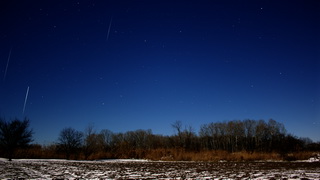
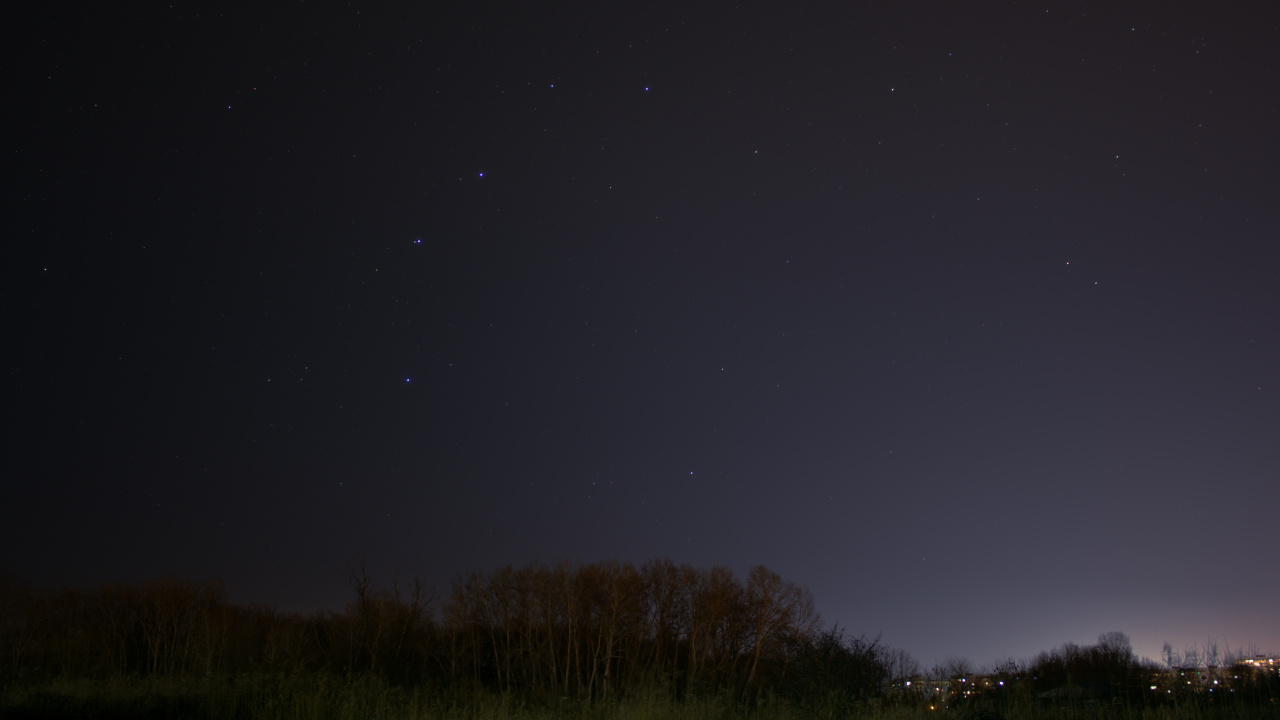
This is what the sky looked like closer to midnight. Unfortunately, no falling stars were captured here. My camera can only record sufficiently bright meteors, and the lens covers less than 10 % of the starry sky. Already during shooting, it was noticeable that the sky quality was gradually deteriorating, with haze appearing in places.
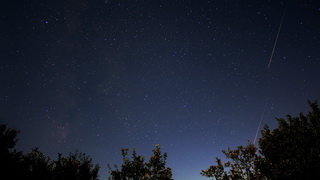
This time, I more often observed the area of the sky near the radiant, which is located in the constellation Gemini. That’s where the meteors were coming from, and it was clearly visible from their trajectories. I decided to shoot the area of the sky next to the constellation Orion. During the shooting, the street lighting was turned off, which noticeably improved star visibility. A couple of meteors were captured there as well.
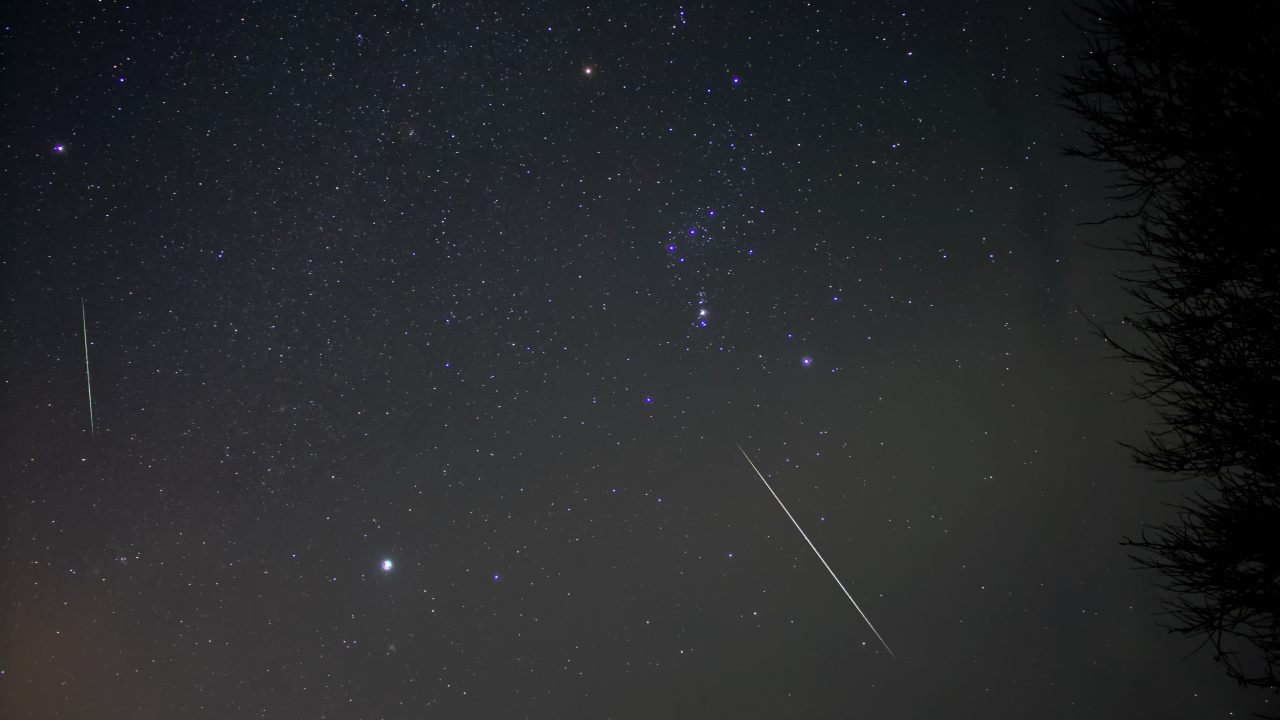
But soon the sky began to rapidly cover with haze.
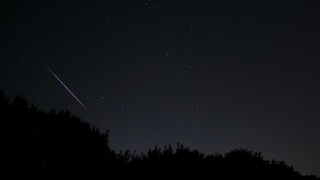
And this is the area of the sky overlooking the city, where a small patch of clear sky remained, but it too was completely covered during the shooting. Here, one meteor was captured over the forest.
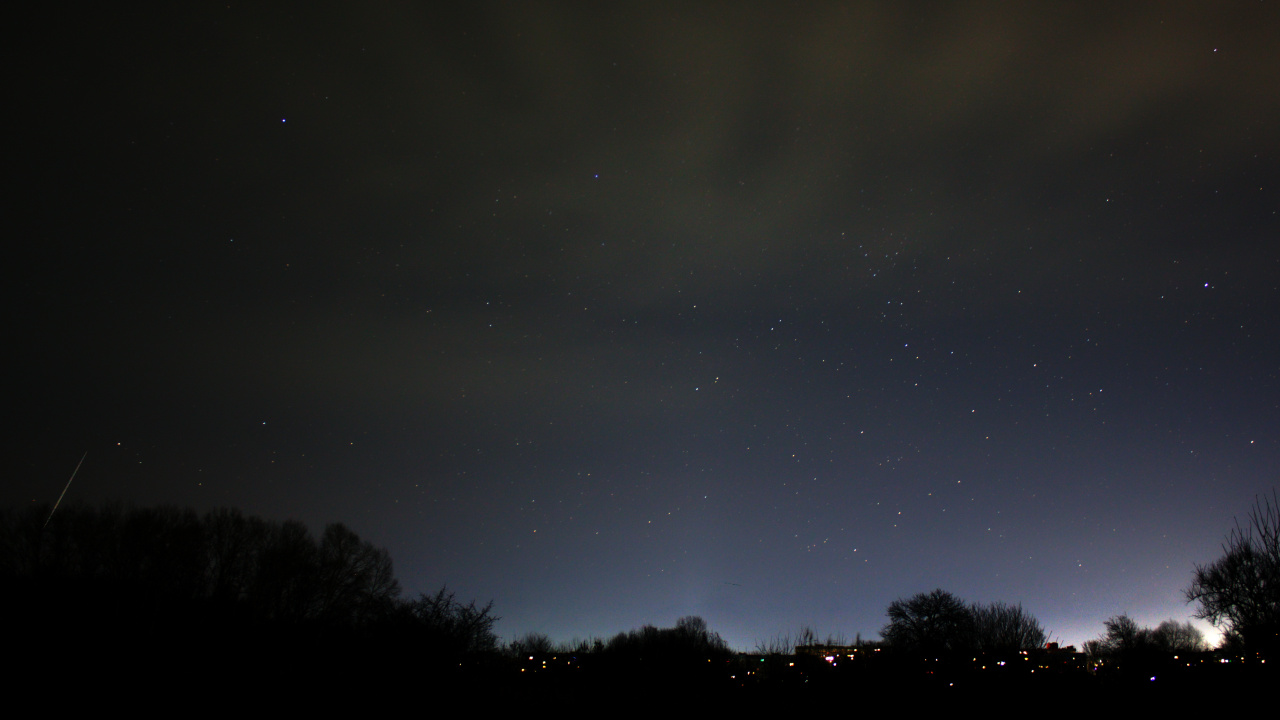
One can say that I was already lucky that the weather “cleared” the sky for a short time for observations, because it might not have happened at all, and the very next evening it snowed.
Observing falling stars is a very interesting and fascinating activity, but it requires a lot of patience and attention. This time, I managed to see 22 falling stars in a couple of hours of observation. Under the best conditions, up to 60 can usually be seen in the same time. I mostly saw white-colored meteors, just like last time. They were of medium brightness — I didn’t notice any very bright or faint ones. This time, observations were hindered by city light pollution and not the clearest sky, which soon became completely overcast. Nevertheless, I am very pleased with this observation and the meteors captured in photos.