Geminids 2024
I had heard many times about the Geminid meteor shower, which reaches its peak activity every year in mid-December, around the night of the 13th to 14th. However, I had never managed to observe it myself—unlike the Perseids, which I watch every year. The reason is simple: in our latitudes, December is the cloudiest month of the year. The sky often remains covered with thick clouds for weeks, and short clearings are so rare that the chances of clear skies exactly during the peak are extremely low. On top of that, I often simply forgot about it.
This year, however, circumstances were different: the sky turned out to be unusually clear, and I simply couldn’t miss such an opportunity. It seemed everything was working in my favor, but another unfavorable factor came into play—full Moon. In December, the Moon climbs high above the horizon, and its bright light significantly reduces the visibility of faint meteors, effectively “washing out” the sky. For observations, it’s hard to imagine worse conditions. Adding to that were the traditional winter hardships: clear weather almost always comes with severe frost (about -10 °C that evening), and doing night-time astronomy in the cold is not exactly pleasant.
Nevertheless, the chance to see the Geminids with my own eyes was too rare to ignore. Traveling out of town under a full Moon and in such frost made little sense, so I observed right from the garden. The radiant of the shower lies in the constellation Gemini, but due to the bright Moon, looking in that direction was pointless. Instead, I focused on the northern parts of the sky, positioning myself with my back to the Moon.
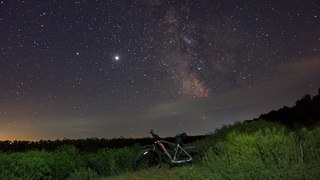
This is what the observation spot looked like that evening:
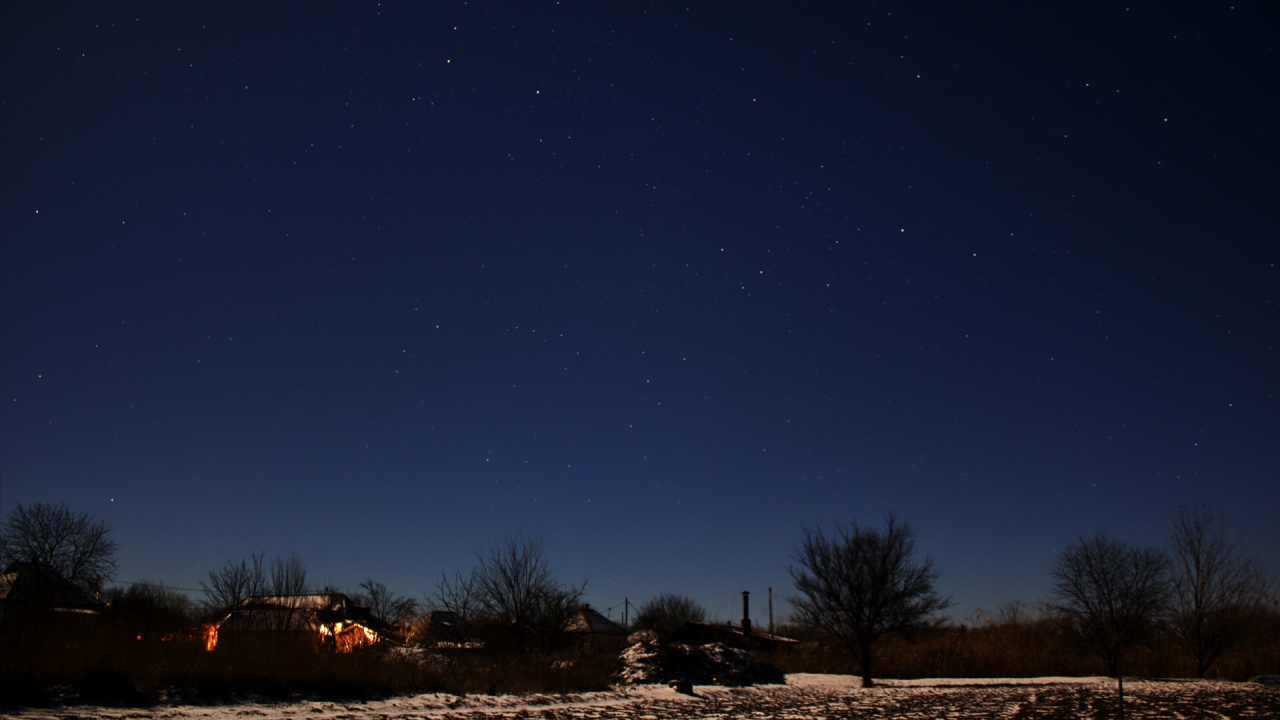
Observations began shortly after 1 a.m. To my surprise, despite the heavily moonlit sky, the number of visible meteors turned out to be quite sufficient. Both bright and less noticeable meteors appeared in view, so there was no boredom.
In addition to visual observations, I took several series of photographs, 200 frames each. I used a Canon EOS 550D camera with an 18–55 mm lens on a tripod. I hoped to capture something, though the chances were slim due to the limitations of my gear and the bright sky, which greatly reduced meteor contrast.
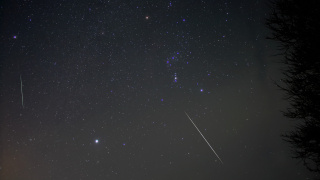
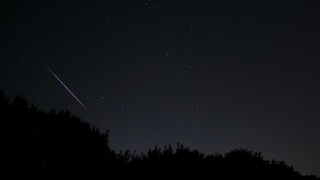
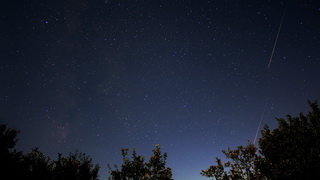
However, when reviewing the shots, I found three captured meteors in one of the series. They weren’t particularly bright, but they were definitely meteors, not satellites. All the more so because I had visually observed them in the same part of the sky where the camera was aimed. Distinguishing meteors from satellites is easy: they follow a single trajectory and, unlike satellites, appear only on a single frame.
But capturing meteors is only part of the task. The next challenge is processing the images so the meteors remain visible in the final composite. To achieve this, all frames—or at least around 80 of them—need to be stacked to improve image quality, after which the frames with meteors must be separately aligned and blended in. This is necessary because the sky continuously rotates, so you can’t just combine multiple shots taken at different times.
After many experiments with processing, I finally managed to produce a final image with meteors.
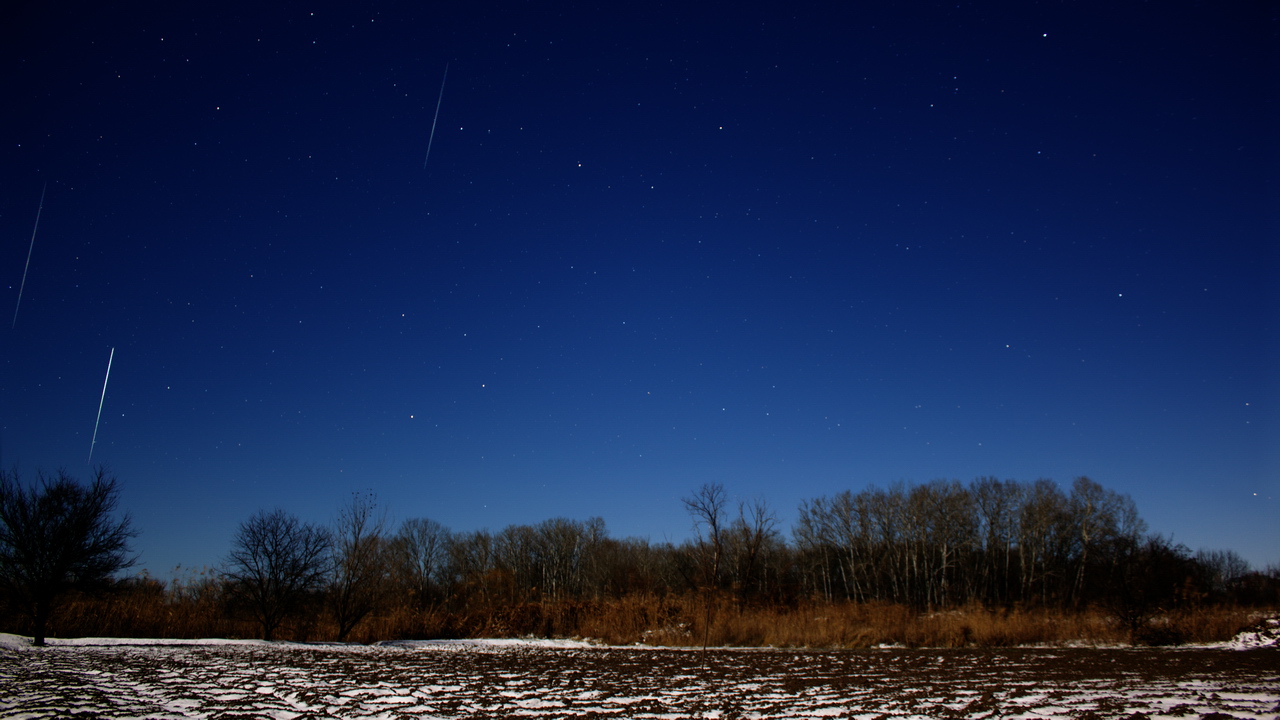
For the final frame, I took 200 shots with the following settings: 10-second exposure, ISO 400, aperture f/3.5. These are fairly “soft” settings—using harsher values would have overexposed the frames, making them almost like daytime shots. Such parameters allow a balance between star brightness and the night sky background. I used only about 80 frames for stacking, including those with meteors. Using all 200 wasn’t necessary—the resulting image quality was already quite good.
I consider this a real success, especially given the equipment I used and the challenging shooting conditions.