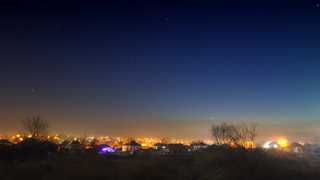
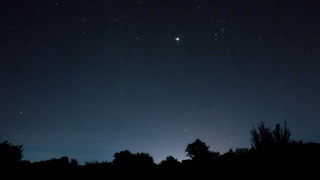
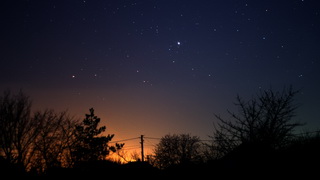
Venus and Jupiter Conjunction
Of all planetary conjunctions with each other, the most spectacular are considered to be the conjunctions of Venus with Jupiter. This is because Venus and Jupiter are the brightest planets in the night sky, and their close approach looks especially beautiful and unusual. It’s hard not to notice something like that. One of the brightest astronomical events of 2023 was the conjunction of Venus and Jupiter, which took place in early March.
The planets began approaching each other in the sky as early as February, but the peak of this phenomenon occurred on March 2. At the moment of closest approach, on March 2, the angular distance between them was only about 0.5° — roughly the apparent diameter of the full Moon. Venus, with a magnitude of about –4m (very bright), and Jupiter (–2m) were easily visible to the naked eye right after sunset in the western part of the sky, approximately 30–60 minutes after sunset. The planets were located in the constellation Pisces and rose to a height of up to 30° above the horizon at mid-latitudes.
This conjunction was especially noticeable because the planets appeared to be literally “kissing” — they could both fit in the field of view of binoculars or a telescope at the same time. The event attracted the attention of millions of people around the world: observers actively shared photos and impressions on social media and astronomy forums. It was practically impossible to miss such a phenomenon.
I didn’t take photographs of these planets through a telescope, even though they fell within its field of view. Getting a high-quality shot of both planets simultaneously at high magnification is quite challenging. The conjunction looked most impressive in the sky itself, so I decided to photograph Venus and Jupiter against the backdrop of a cityscape.
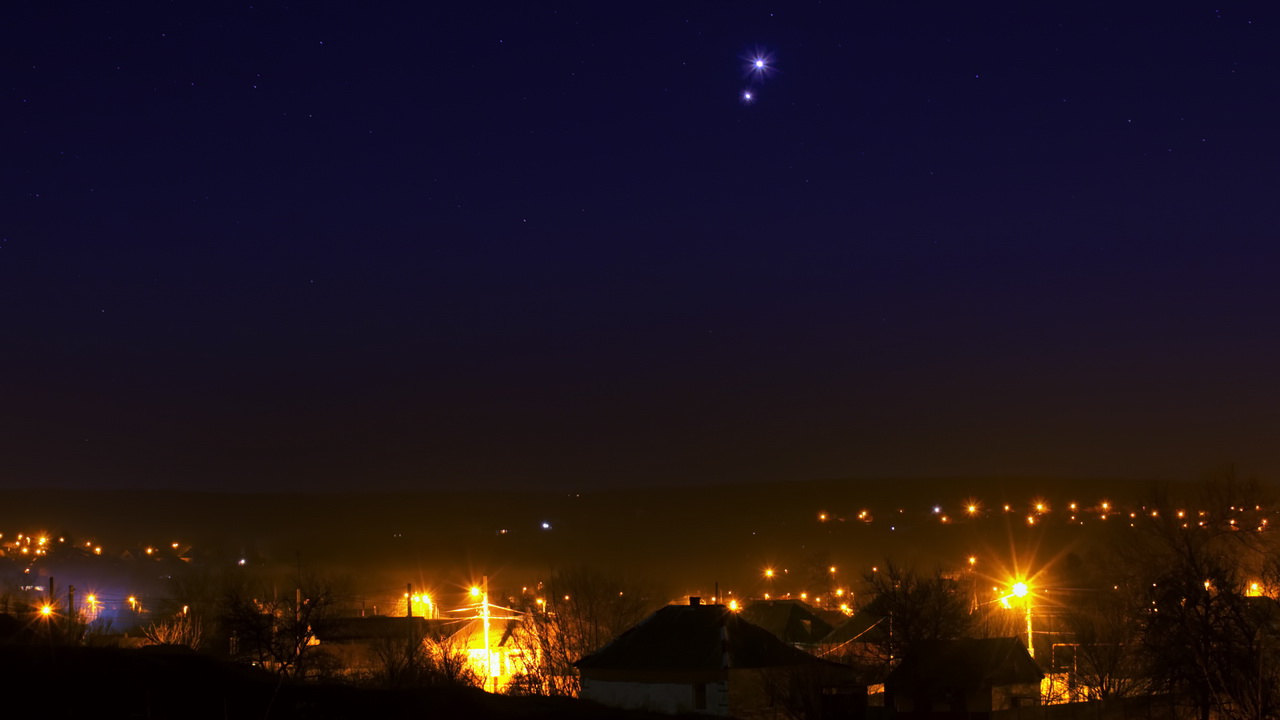
For the shooting location, I chose the “Nameless Hill” near the flooded quarry in the village of Diivka, in the city of Dnipro. From there, there is a good view of the required part of the sky, as well as a beautiful panorama of the village and the forest on a distant ridge. The spot turned out to be successful. I rode there by bicycle at the right time, taking my camera and tripod with me. The photo was taken on March 2 with a Canon EOS 550D camera and an 18-55mm lens. That evening, the distance between the planets was about 40 arcminutes, or 0.66°.
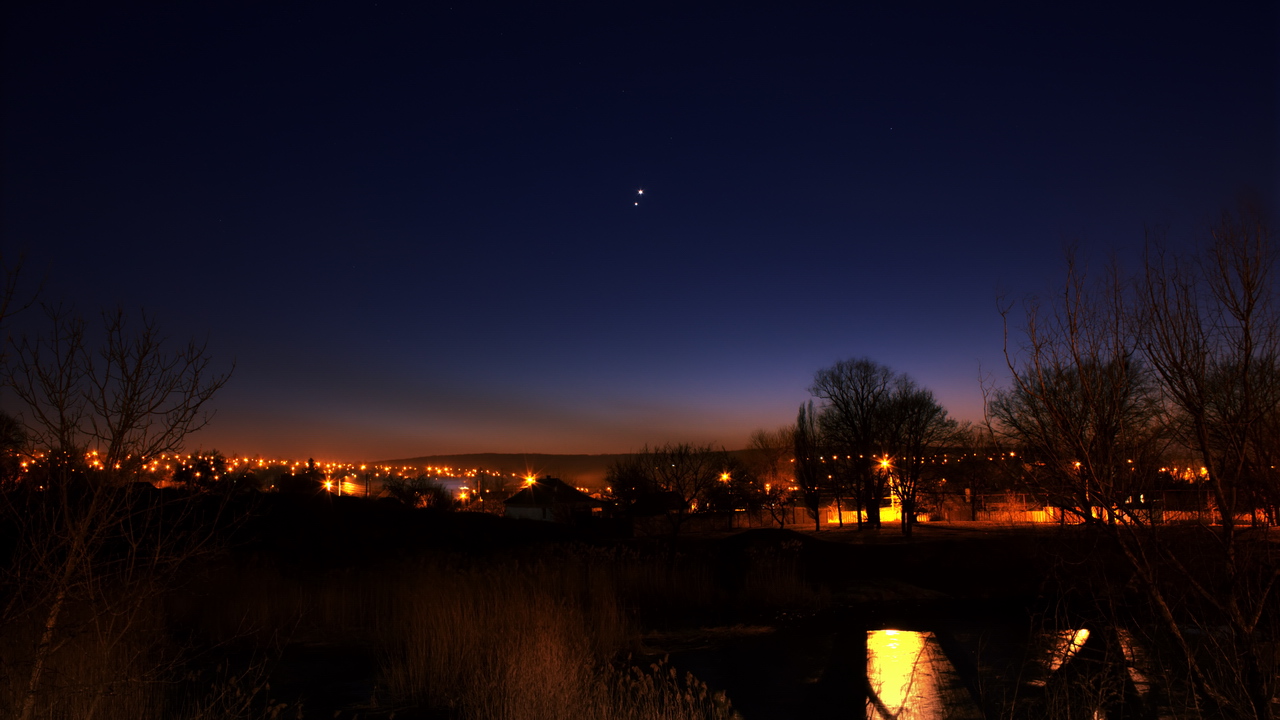
Here, the brighter Venus is positioned above the less bright Jupiter. In my opinion, the photograph turned out very successful and is one of my favorites. The only drawback is that the other stars didn’t come out well in the shot, and apart from Venus and Jupiter, almost no other stars are visible. This is probably due to not-quite-optimal shooting settings. It was difficult to find parameters that would make both the stars and the cityscape with its many bright streetlights look good at the same time.
The next photo was taken the same evening, but a bit later, when the planets had descended lower toward the horizon, and with higher magnification.
Even though planetary conjunctions happen regularly, each one is unique and unrepeatable in its own way. The Venus–Jupiter conjunction in the spring of 2023 became one of those moments that stay in memory for a long time and once again confirm how beautiful the starry sky can be, even without using special astronomical observation equipment.